
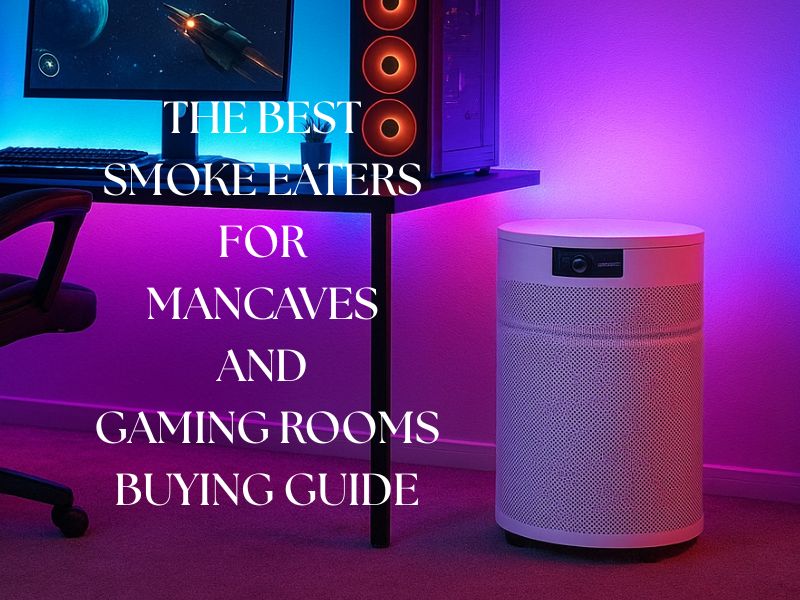


If your mancave or gaming room fills with cigarette smoke, vape haze, or that lingering, stale smell after long sessions, it quickly stops being the retreat you built. I get why you want clean air that doesn’t steal the vibe — conversation, audio clarity, and even your gear stay better when the air is fresh.
That’s why I pulled together the best smoke eaters and compact air purifiers made for enclosed personal spaces. This roundup focuses on real-world needs, such as room size, noise, maintenance, and budget, so you can pick a model that keeps your space comfortable without killing the atmosphere. Scroll on to find the right match for your setup.
Best Overall: Airpura T600 DLX Air Purifier for Heavy Tobacco Smoke & VOCs
Best for Compact Spaces: Airgle AG600 Air Purifier
Best for Bedrooms or Dual-Use Spaces: Austin Air Bedroom Machine
Best High-Capacity Option: Airpura C700 DLX Air Purifier
Best Portable Choice: Airgle AG25 Personal Air Purifier
T600 DLX Air Purifier for Heavy Tobacco Smoke & VOCs by Airpura
If your mancave doubles as a smoking lounge, the Airpura T600 DLX is the kind of powerhouse you want humming quietly in the corner. Built specifically to tackle heavy tobacco smoke and VOCs, this purifier uses a massive 26-pound activated carbon filter that absorbs even the most stubborn odors. I noticed how it neutralized lingering smoke fast, not just masking it, but scrubbing it away. The airflow feels balanced, and the 560 CFM motor circulates clean air across spaces up to 2,000 square feet without pushing harsh drafts. Its powder-coated steel housing gives it an industrial confidence, yet it blends well into any setup.
What I love most is how it doesn’t generate ozone, making it safe to run for hours. For anyone serious about maintaining clean, breathable air in a cigar-friendly room, the T600 DLX makes a huge impact without compromise.

| Pros | Cons |
|
|
Airgle AG600 Air Purifier
The Airgle AG600 is the one I turn to when I want powerful purification in a compact package. Designed for smaller setups, it keeps the air crisp in spaces up to about 300 square feet, which is perfect for a gaming room or office corner. I can actually feel the air circulation working — the 360-degree system ensures every bit of the room gets refreshed multiple times per hour.
What makes it stand out is its medical-grade filtration and Airgle’s advanced PCO technology, which breaks down airborne pollutants instead of just trapping them. The difference is tangible — the air smells clean, not filtered. I also appreciate the soft sound profile, only 33 to 55 decibels depending on fan speed, so it never distracts from gaming audio or conversations. For anyone who values quiet performance and hospital-level air quality in a personal space, the AG600 delivers way above expectations.

| Pros | Cons |
|
|
The Bedroom Machine for Chemicals, Smoke & Odor Removal
The Austin Air Bedroom Machine became my go-to when I wanted something that didn’t just clean air — it actually improved how I felt overnight. It’s tested by Johns Hopkins University, and I can see why it has such a reputation. Even after hours in a smoke-filled lounge or gaming setup, this purifier restores freshness that feels almost therapeutic. The 5-stage filtration system captures microscopic particles, odors, and chemical vapors, and it runs quietly enough that I forget it’s on.
I really like the 360-degree air intake, which keeps the airflow consistent no matter where I place it. Covering up to 1,500 square feet, it’s strong enough for larger spaces but refined enough for a bedroom or office corner. Knowing it’s made in the USA and endorsed by the National Sleep Foundation adds extra peace of mind — it feels like a purifier built for both rest and recovery.

| Pros | Cons |
|
|
C700 DLX Air Purifier for VOC & Gas Abatement Plus by Airpura
When I first ran the Airpura C700 DLX, I noticed how quickly it transformed the air — that heavy, chemical-laden feeling just disappeared. This purifier isn’t just about removing smoke; it’s designed for serious VOC and gas abatement, making it perfect for rooms that double as creative or smoking spaces. With a 635 CFM airflow rate, it refreshes every corner of the room multiple times an hour, leaving behind clean, breathable air that actually feels lighter.
The 26-pound enhanced activated carbon filter — made from 100% coconut shell — absorbs toxic gases with ease, while the HEPA barrier takes care of fine particles. I appreciate the quiet confidence of its variable-speed motor: you can barely hear it on low. Its powder-coated steel housing looks sharp in black, white, or cream, and the smooth-rolling casters make it easy to move around. For large spaces up to 2,000 square feet, this model feels like an air detox system built for serious comfort and peace of mind.

| Pros | Cons |
|
|
Airgle AG25 Personal Air Purifier
When I’m on the move — driving, working, or traveling — the Airgle AG25 is the purifier I keep within arm’s reach. It’s light, slim, and surprisingly strong for such a small footprint. Despite weighing just over three pounds, it uses the same advanced PCO technology as Airgle’s larger units, actively breaking down VOCs, odors, and fine smoke particles. What I appreciate most is its versatility — I can plug it into the car for a smoke-free commute or set it up beside my PC.
The three-mode control makes it effortless to switch between quiet focus and maximum cleaning power. Even after long use, it runs cool and consistent. The build feels premium, and with FDA and CE certifications, it’s as professional as personal purifiers get. Whether for travel, work, or gaming in smaller spaces, the AG25 makes sure I’m always breathing clean, refreshed air wherever I am.

| Pros | Cons |
|
|
MinusA2 Ultra Quiet Air Purifier by Rabbit Air
When I first tested the Rabbit Air MinusA2 Ultra Quiet Air Purifier, what stood out immediately was how smart and unobtrusive it felt. This model reads the room like it has intuition — its odor and particle sensors automatically adjust fan speed the second smoke or stale air builds up. I could feel the difference within minutes. The air becomes lighter, fresher, and noticeably cleaner, even in a busy gaming setup with multiple monitors and people hanging out.
With its sleek 7-inch depth, it mounts easily on the wall, saving precious desk or floor space. I appreciate how energy-efficient it is too, running on as little as 7 watts while staying whisper-quiet — quieter than a console fan. Covering up to 815 square feet, it’s perfect for larger mancaves. The MinusA2 doesn’t just purify air — it completely transforms how your personal retreat feels.

| Pros | Cons |
|
|
DesignAir P600 – Portable Electronic Air Cleaner
When I brought the DesignAir P600 into my gaming room, I was skeptical about how a “portable” air cleaner could handle real smoke buildup. Within the first day, I was convinced. This machine’s electronic filtration system is no gimmick — it uses a combination of foam pre-filters, high-efficiency collector cells, and honeycomb carbon filters to capture particles as fine as 0.1 microns.
You can almost feel the crispness in the air after a long gaming night. I like its compact, powder-coated design and the solid hum of the 1/25 HP motor — steady but not distracting. Even at its highest speed, it’s no louder than a typical PC fan. With coverage up to 1,500 square feet, it fits perfectly in a mid-sized entertainment room. The fact that it’s lab-tested to MERV 16 efficiency gives me peace of mind knowing it’s truly catching what I can’t see.

| Pros | Cons |
|
|
HealthMate Plus Air Purifier by Austin Air
The Austin Air HealthMate Plus feels like having a professional-grade purifier designed for home comfort. I’ve used it in spaces where smoke, chemical fumes, and strong odors tend to linger, and it makes an immediate difference. The 360-degree intake system pulls air from all sides, cleansing it through a four-stage filter setup that traps 99.97% of particles down to 0.3 microns and even smaller. I love the balance of power and simplicity — three speed settings, a steel body, and a design that just works.
When running on high, it cycles the air twice per hour in a large 1,500-square-foot room, keeping the air noticeably lighter. It’s especially helpful for anyone with allergies or sensitivity to chemicals. What I appreciate most is its quiet confidence — no Wi-Fi gimmicks, no unnecessary flash — just pure, efficient air cleaning that delivers consistent comfort.

| Pros | Cons |
|
|
Airgle AG900 Clean Room Air Purifier
The Airgle AG900 is the kind of machine you add when you’re serious about air quality. I started using it in a smoke-heavy recreation room, and it’s now the quiet guardian of the space. The medical-grade HEPA filter captures 99.99% of airborne particles, while the activated carbon layer pulls out odors before you even notice them.
But what really sets it apart is Airgle’s Titanium Pro module — a PCO technology that safely breaks down microscopic pollutants and VOCs, something you can almost sense in the air after an hour. Covering up to 617 square feet, it’s ideal for concentrated setups where air gets dense quickly. The fan hums softly, between 33 and 68 dB, depending on speed, and it feels premium from every angle — solid, well-built, and precise. Whenever I walk into that room now, the air feels cleaner than ever, and I never have to think twice about what I’m breathing.

| Pros | Cons |
|
|
MiracleAir PM-400 Portable HEPA Air Cleaner
I was impressed by the MiracleAir PM-400 the first time I powered it up — it’s a solid commercial-grade purifier that means business. The airflow is smooth but powerful, cleaning up spaces to 1,500 square feet with ease. What sets it apart for me is its industrial-grade filtration setup. The true HEPA filter, combined with a pre-filter and optional 15-pound carbon layer, does an exceptional job eliminating smoke residue, vapor, and even that faint film tobacco can leave behind on surfaces. After using it for a week, I noticed my mancave stayed cleaner, and that lingering smell was practically gone.
The PM-400 also runs quietly for its size — just 35 dB on low — which makes it easy to keep running during long gaming sessions. With a powder-coated finish and durable build, this purifier feels like something you’d find in a professional studio — rugged, reliable, and surprisingly refined.

| Pros | Cons |
|
|
AG300 5-Speed Portable Air Filter Purifier
The AG300 may be small, but it completely changed how I view portable air purifiers. Built with an H14-rated cHEPA filter, it captures particles far smaller than typical purifiers can touch — as tiny as 0.003 microns, which is impressive by any standard. When I use it in my smaller gaming area or office, the air feels noticeably fresher within minutes. It’s light, under 15 pounds, and has five fan speeds, giving me complete control over how quiet or powerful I want it to run. Even at higher speeds, it’s not overly noisy, topping out at around 65 dB.
The built-in UV-C lamp and carbon filter add an extra layer of safety by neutralizing bacteria and odors. Its sleek plastic housing looks modern on a desk or shelf, and I love that it’s energy-efficient, pulling minimal wattage even during long sessions. It’s compact power at its most practical.

| Pros | Cons |
|
|
Key Variables to Look Out For
These are the core variables I check first when picking a smoke eater for a mancave or gaming room. Each item below explains what to look for, why it matters in small, often smoky spaces, and practical tips you can use when comparing models.
Airflow capacity (CFM / CADR)
-
What it means: How much air the unit moves (CFM) or the clean-air output for smoke/particles (CADR).
-
Why it matters: Faster airflow clears smoke and odors quicker in enclosed rooms. A weak unit will struggle to keep air fresh.
-
Practical tips:
-
Look for CADR or CFM specs and match them to your room (higher for small rooms that get heavy smoke).
-
Aim for devices that can deliver 4–6 air changes per hour (ACH) in the space for noticeable improvement.
-
If manufacturer info is vague, favor models that state CADR for “smoke.”
-
Filter type (HEPA, activated carbon, electrostatic, etc.)
-
What it means: The technology that traps particles and removes odors/chemicals.
-
Why it matters: Smoke has both particles (soot) and gases/odors — you need the right combo.
-
Practical tips:
-
True HEPA for fine particles (most cigarette and vape aerosols).
-
Thick activated carbon for odors and VOCs — look for high carbon weight or special odor cartridges.
-
Electrostatic/ionizing can help but check for ozone production; prefer models that don’t rely solely on ions.
-
Noise level
-
What it means: Sound output, typically measured in decibels (dB).
-
Why it matters: Mancaves and gaming rooms need quiet for music, voice chat, and immersion.
-
Practical tips:
-
Check dB ratings at different fan speeds; “low” should sit below ~40 dB for quiet sessions.
-
Choose units with a true quiet or “night” mode if you game with voice comms or stream.
-
Bigger fans can be quieter at the same airflow — don’t assume bigger = louder.
-
Room size compatibility
-
What it means: The square footage or volume the unit is designed to handle.
-
Why it matters: An undersized purifier won’t keep up with smoke in a sealed room.
-
Practical tips:
-
Match the unit’s recommended room size to your actual room; factor in layout and closed doors.
-
For attics/basement-style mancaves with low ceilings, use the manufacturer’s cubic-foot guidance when available.
-
If in doubt, choose a model rated for a slightly larger room than yours.
-
Maintenance & filter replacement
-
What it means: How often filters need replacing and how easy that process is.
-
Why it matters: Dirty filters reduce performance and increase long-term cost — frequent smoking speeds clogging.
-
Practical tips:
-
Check replacement costs and expected life (months) per filter.
-
Prefer models with simple tool-free access and widely available filters.
-
Consider washable pre-filters to extend life of HEPA/carbon elements.
-
Energy efficiency
-
What it means: Power draw during operation (watts) and overall operating cost.
-
Why it matters: Many users run purifiers for hours; efficiency affects electricity bills.
-
Practical tips:
-
Look for ENERGY STAR or low-watt models if you plan continuous use.
-
A higher upfront cost can be worthwhile if it means lower power draw and better filters.
-
Mounting or placement options
-
What it means: Whether the unit is portable, wall/ceiling-mountable, or desktop.
-
Why it matters: Placement changes effectiveness — floor vs. high wall placement, airflow patterns.
-
Practical tips:
-
Portable units give flexibility for parties or multi-room use.
-
Wall/ceiling models save floor space and can be effective at pulling up rising smoke/heat.
-
Avoid hiding units behind furniture — they need clear intake and exhaust.
-
Additional features (sensors, auto modes, smart controls, safety)
-
What it means: Built-in sensors, app control, timers, and safety features.
-
Why it matters: Sensors and auto-modes help the unit respond to spikes in smoke without babysitting.
-
Practical tips:
-
Prefer accurate PM or VOC sensors and a reliable auto mode.
-
Smart features are nice but prioritize sensor quality over flashy apps.
-
Avoid or be cautious with ozone-generating devices — they can harm indoor air quality.
-
Price vs. longevity (total cost of ownership)
-
What it means: Upfront price plus ongoing filter and energy costs over time.
-
Why it matters: A cheap unit can end up costing more if filters are expensive or it has poor durability.
-
Practical tips:
-
Calculate annual filter cost + estimated electricity to compare models fairly.
-
Invest in durable housings and replaceable parts if you smoke regularly in the room.
-
For heavy use, prioritize replaceable high-capacity carbon and HEPA combos over disposable all-in-one units.
-
Use these variables as a checklist when comparing models — the right balance depends on how heavily the space is used, how sensitive you are to noise and smell, and whether portability or permanent mounting fits your setup.
Frequently Asked Questions
How does a smoke eater differ from a regular air purifier?
A smoke eater is built specifically to remove smoke particles, tar, and odor molecules from the air — not just dust and pollen. These units typically use a combination of HEPA filtration, activated carbon, and sometimes electrostatic or PCO technology to break down the fine particulates and gases that come from smoking or vaping.
What size smoke eater do I need for my mancave or gaming room?
It depends on your room’s square footage and how often you smoke inside. For smaller rooms under 400 square feet, compact units like the Airgle AG600 work well. Larger mancaves benefit from higher-capacity systems like the Airpura T600 DLX or C700 DLX, both rated for up to 2,000 square feet.
Are smoke eaters noisy?
Noise varies by model, but most modern smoke eaters operate between 30 and 60 decibels — about the sound of a quiet conversation or a desktop fan. If low noise is a priority, look for units with variable speed controls and “quiet mode” settings, such as the Rabbit Air MinusA2 or Austin Air Bedroom Machine.
Do smoke eaters remove all odors?
Yes, when properly sized and maintained. The key is having enough activated carbon in the filter — that’s what absorbs the odor molecules. Units like the Airpura T600 DLX and C700 DLX use thick carbon beds specifically designed to remove the strong smell of tobacco and cigars.
How often should filters be replaced?
Filter life depends on usage. HEPA filters typically last one year, while activated carbon filters can last two years with moderate use. Prefilters may need cleaning or replacement every few months, especially in smoke-heavy environments. Always check the manufacturer’s schedule to maintain efficiency.
Can I use a smoke eater continuously?
Absolutely. Most are designed for continuous operation and low power consumption. Running your unit around the clock keeps air quality stable, especially in enclosed rooms that see frequent smoking or limited ventilation.
Breathe easy, play on
Clean air changes how a mancave or gaming room feels — less coughing, clearer voices on mic, and a space that actually invites you to stay. This roundup focused on practical options that remove smoke, cut odors, and keep the room comfortable so your setup works as intended.
And if you’re looking at cigar essentials to elevate your space, check out the best Cigar humidor cabinets, pair them with a reliable Cigar humidor humidifier, and explore premium Smoke eaters and Cigar accessories for a complete setup.
Choose the mix that fits your space and habits. You deserve high-quality air and comfort in your personal spaces.


