
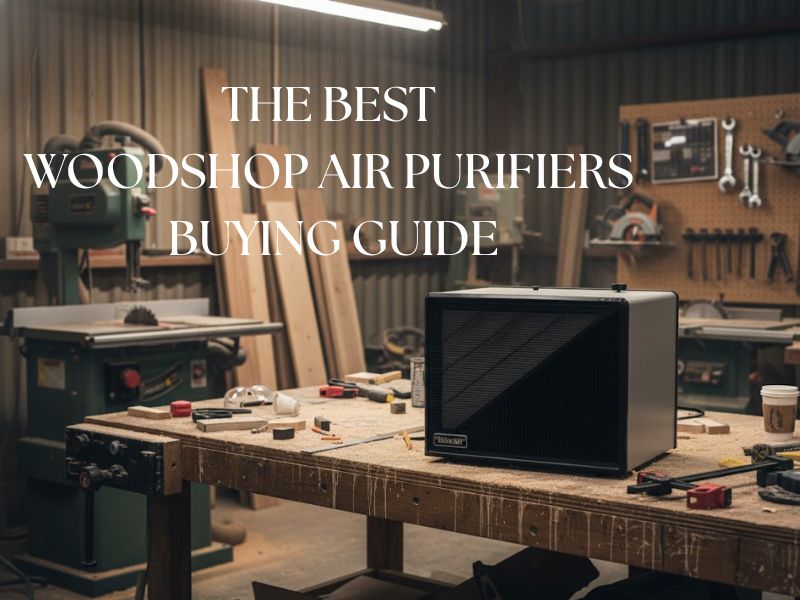


A woodshop's air isn't just dusty, it's a mix of fine sawdust, volatile fumes from finishes, and the occasional smoke event. I'm not a woodworker, but I spend time with people who are, and they've taught me that a rugged, high-flow purifier makes the difference between an irritating cough and a workspace you can actually work in for years.
Remember, this roundup is perfect for those looking for air purifiers/smoke eaters for woodshops. I tested specs, filter types, CADR numbers, and real-world durability to bring options that tackle fine particulate, capture smoke and VOCs, and stand up to the shop environment. Below you'll find practical picks—quiet bench units to heavy-duty shop machines, so you can pick the right protection and get back to cutting.
My Top Picks
Best Overall for Heavy Woodshop Dust & Smoke: LA2-RC2-MH High-Performance Wood Shop Air Filtration System
Best for Large, Fully Equipped Woodshops: LA2000-S Electrostatic Industrial Air Purifier
Best Budget-Friendly Commercial HEPA Option: Maxum HEPA Air Purifier
Best for Targeted HEPA Filtration Near Cutting/Sanding Stations: LA2-RC1-HOC HEPA Air Purifier
LA2-RC2-MH High-Performance Wood Shop Air Filtration System
Using the LA2-RC2-MH has been one of the easier decisions I’ve made when outfitting a woodworking space. I depend on filtration that can keep up with constant fine dust, and this system’s 900–1800 CFM range lets me adjust airflow depending on how demanding the day’s work is. What really gives me confidence, though, is its 99.97%+ filtration efficiency down to 0.3 microns. Even after long ripping or sanding sessions, the air feels noticeably clearer, and I’m not left with that faint haze hanging above the machines.
The dual regular and dual mini filter slots give me flexibility when I need to cycle filters quickly during peak production. At 120 lbs, the unit is sturdy without being impossible to maneuver during placement. It pulls 516 watts and runs at 43–69 dB(A), which feels like a practical balance between power and noise. I also appreciate the clean, squared design—it comes in both black and white vinyl, so I can match it to the space instead of sticking out like industrial equipment often does. With a 7-year limited warranty, this is the filtration system I trust when I need both power and precision in an active shop.

| Pros | Cons |
|
|
LA2000-S Electrostatic Industrial Air Purifier
When I first worked with the LA2000-S, what stood out immediately was how confidently it handled heavy particulate without bogging down the workspace. I like equipment that doesn’t overpromise, and this unit’s dual electrostatic cell system really does deliver stronger performance than the typical double-filter setups I’ve tested. With output ranging from 1500 to 2000 CFM, I’ve watched it keep up with everything from welding haze to the kind of fine airborne debris you get in busy production environments. What I appreciate most is that the purification doesn’t come at the cost of usability—the sound profile stays within a reasonable 53–65 dB(A), so I never feel like it's drowning out the room.
Its 97% particle removal efficiency feels solid in real-world operation, and the included carbon filter helps cut down on lingering fumes in mixed-use shop areas. The build is compact for a powerhouse, measuring 21" x 21.5" x 19" and weighing 79 lbs, which makes ceiling or wall placement straightforward. I run mine on 120V, but I like that it supports 230V installs as well. With a 7-year warranty backing it, this is the kind of purifier I rely on when I want industrial strength with long-term dependability.

| Pros | Cons |
|
|
Maxum HEPA Air Purifier for Commercial and Light Industrial Use
When I first brought the Maxum HEPA into a workspace, what impressed me was how confidently it handled both particulate and odors without feeling oversized or power-hungry. I like units that bridge the gap between home-grade simplicity and commercial-level output, and this one fits that sweet spot. With a 150–500 CFM range, I can run it low when I’m maintaining general air clarity or bump it up when I’m dealing with heavier particulate or lingering smells. The included carbon filtration is genuinely useful—not a token add-on—especially when smoke or VOCs creep into the environment.
Even at mid-range airflow around 218 CFM, it stays at a comfortable 43 dB(A), which means I can keep a conversation going without shouting over it. Its small footprint—19" x 15" x 15"—and 32-pound weight make placement incredibly easy, whether I’m setting it near a workstation or using it to support a larger filtration setup. I also like how energy-efficient it is: 89 watts at that same mid-speed and never more than 150 watts even at max draw. This is the purifier I reach for when I want steady, reliable filtration that doesn’t require industrial power or installation.

| Pros | Cons |
|
|
LA2-RC1-HOC HEPA Air Purifier
The LA2-RC1-HOC has become one of my go-to units when I need focused, high-efficiency filtration in a moderate-sized space. What I like immediately is the 600 CFM blower paired with a true 6-inch HEPA filter—because that combination gives me real confidence that fine airborne contaminants aren’t slipping through. With its 99.97% capture down to 0.3 microns, I can rely on it during long workdays when dust, smoke, or odor buildup would normally start to settle in the air.
The flexibility of this system is another reason I keep reaching for it. I’ve mounted it on ceilings, walls, and even rolled it around on a cart depending on how the space is set up. At 21.5″ x 20.5″ x 19″, it’s compact enough to tuck away, but the 105-pound steel body feels rock solid. The five-chamber carbon filter is a noticeable upgrade from basic carbon pads, especially when I need to deal with more stubborn odors. Running at 55–68 dB(A), it stays surprisingly manageable for the amount of airflow it pushes. Operating on 115 volts at just 3 amps, it’s reliable, efficient, and steady—exactly what I look for when I need strong HEPA performance without overcomplicating installation.

| Pros | Cons |
|
|
MaxMount1500 Commercial Air Purification System
The MaxMount1500 instantly won me over because it blends strong performance with a clean, professional look. I’ve always preferred equipment that doesn’t scream for attention, especially when it's mounted overhead, and this unit’s 18-gauge steel cabinet fits in beautifully without compromising durability. With 1,250 CFM of airflow and dual-speed control, I can tailor the output to match whatever is happening in the room—heavier smoke moments or steady all-day filtration.
Its dimensions—35.375″ x 25.5″ x 17.625″—give it a low, balanced footprint that hangs easily using the included eye lags, S hooks, and industrial wire. At 125 lbs, it’s solid, but once installed, it feels like a permanent part of the space. I run mine off the 1/2 hp motor drawing 9 amps, and the 120V standard plug makes setup simple. Noise-wise, it sits around 65–68 dB depending on the setting, and in my experience, that’s a comfortable range for commercial environments where background activity is normal. For anyone who needs a purifier that works hard without looking like industrial machinery, the MaxMount1500 fits that niche perfectly.

| Pros | Cons |
|
|
MaxMount2000 Commercial Air Purification System
Whenever I need the kind of airflow that can handle busy, high-pollution environments, I reach for the MaxMount2000. With 1,650 CFM of power, it’s built for spots where contaminants build quickly—lounges, bars, kitchens, grow rooms, even larger commercial areas. What I appreciate most is how discreet it is once installed. The ducted setup keeps the unit hidden, and the internal insulation helps it run more efficiently without adding harsh mechanical noise.
Its multi-stage filtration is exactly what I need when the room cycles through constant pollutants. Whether it’s smoke, heat, or mixed odors, this system doesn’t hesitate. The 18-gauge steel cabinet is built to last, and even though it weighs 125 lbs, installation with the provided hardware has consistently been straightforward for me and the teams I’ve worked with. Powered by a 1/2 hp motor drawing 9 amps at 120V, it stays predictable and reliable. At 70 dB on high, 67 on low, the sound level feels surprisingly manageable given the performance. This is the model I lean on when I want serious strength paired with unobtrusive placement.

| Pros | Cons |
|
|
MaxMount800 Commercial Air Purification System
The MaxMount800 is the unit I choose when I need strong commercial filtration but don’t require the extreme airflow of its larger siblings. Sitting at 850 CFM, it’s perfectly balanced for moderate-to-large environments where consistent filtration matters just as much as low operational noise. With dual-speed functionality, I can keep things quiet during slower periods and ramp up airflow when the space gets busy.
What impresses me most is how thoroughly the multi-stage system handles airborne contaminants—especially in venues like lounges, kitchens, and mixed-use commercial rooms. It’s fully insulated, which helps keep noise at a reasonable 64–68 dB depending on the speed, so I never feel like I’m competing with the equipment. The 18-gauge steel cabinet gives it a solid, dependable presence, and the unit’s 35.375″ x 25.5″ x 17.625″ size fits comfortably into ducted setups. The 1/4 hp motor drawing 4.2 amps at 120V has proven energy-efficient in my experience, making it easy to run for extended hours. It’s the kind of purifier I count on for clean, consistent results without overpowering the room.

| Pros | Cons |
|
|
Key Variables to Look For
These are the key variables to pay attention to when choosing a woodshop air purifier — each item below explains why it matters and gives tight, practical tips so you can compare models fast.
Filtration type — what the unit actually captures
Why it matters: filter media determines whether you remove fine respirable dust, smoke particles and VOCs from finishes.
-
Prioritize: true HEPA H13 or H14 for ≥99.95% capture of 0.1–0.3 µm particles (sawdust and smoke).
-
Add-on: activated carbon or catalytic beds for VOCs and finishing fumes (solvents, formaldehyde).
-
Avoid or be cautious: ozone generators and standalone ionizers (produce ozone; can worsen air quality).
-
Note: electrostatic precipitators capture particles but may re-release them or require frequent cleaning.
Airflow / CADR / CFM — how much air the unit moves
Why it matters: high filtration efficiency is useless if the unit can’t move enough air to change the shop atmosphere.
-
Use CFM (cubic feet per minute) or CADR ratings for particulates; higher = better for large shops.
-
Rule of thumb: calculate required CFM: CFM = (room volume × desired ACH) ÷ 60. For shops aim for 4–10 ACH depending on activity level (use higher ACH for heavy cutting/finishing).
-
Prioritize variable-speed fans so you can balance performance vs noise.
-
Beware low-CADR units advertised for “shops” — they’re often meant for bedrooms.
Room size & air changes per hour (ACH) — matching unit to space
Why it matters: correct sizing ensures meaningful reductions in dust and smoke.
-
Measure: room volume = length × width × height. Use the CFM formula above.
-
Target ACH: light hobby use 4–6 ACH; full-time small shop 6–8 ACH; heavy multi-station shop or finishing operations 8–12 ACH.
-
If one unit can’t reach required CFM, plan multiple units staged around the shop.
Noise level — usability during work
Why it matters: noisy units get turned down or off; you need filtration that doesn’t interfere with communication or concentration.
-
Check decibels (dB) at operating speeds — compare low/medium/high.
-
Target: ≤60 dB for a tolerable mid-speed; <45 dB if you need quiet for long sessions.
-
Look for efficient motors and larger fans (they move more air at lower RPM/noise).
Maintenance & filter lifecycle — ongoing cost and uptime
Why it matters: replacement filters and downtime drive long-term cost and performance.
-
Check filter lifespan in hours or months, and list cost per replacement set.
-
Prefer models with washable pre-filters to trap large chips and extend HEPA life.
-
Look for easy-access filter doors and clear filter-change indicators.
-
Budget: estimate annual filter cost + electricity before buying.
Placement & airflow strategy — where the unit works best
Why it matters: location determines how quickly pollutants are removed and whether sources are controlled.
-
Place units close to the pollution source (cutting station, finishing booth) and with unobstructed intake/outflow.
-
Combine source capture (local shop dust collection) + room purifiers for best results.
-
Use multiple smaller units to create directed airflow paths if a single large unit can’t be positioned ideally.
Safety features & combustible-dust considerations
Why it matters: wood dust can be flammable/explosive; shop units must not introduce ignition or fail under dusty loads.
-
Require UL/ETL listing; if working in environments with heavy combustible dust risk, consider devices rated for dust-prone areas or explosion-safe equipment.
-
Look for spark arrestors, thermal cutoff/overload protection, grounded metal housings, and sealed motors.
-
Avoid exposing filter housings to sparks (e.g., near grinding or welding) without proper spark suppression.
Operating costs & power draw
Why it matters: energy use and replacement filters determine total cost of ownership.
-
Check wattage at typical operating speeds and estimate kWh: (W ÷ 1000) × hours/day × $/kWh.
-
Compare annual filter spend + electricity to estimate true cost; cheap units often cost more over time.
-
Prefer energy-efficient brushless motors and units with economy/auto modes.
Additional features & controls — convenience that matters
Why it matters: useful controls improve real-world performance and reduce wasteful run-time.
-
Useful: variable speeds, timer, auto mode with particulate sensor, remote/control app, and filter life indicators.
-
Nice-to-have: wheels/handles for mobility, IP-rated controls for dusty environments, washable prefilter.
-
Avoid overcomplicated smart features that are hard to clean or rely on cloud services.
Build quality & serviceability
Why it matters: workshop environments are hard on equipment; repairable, robust units last longer.
-
Look for metal housings, easily replaceable motors/fans, and accessible service parts.
-
Check warranty terms, availability and price of replacement filters, and local service options.
-
Read owner reports for real-world durability in dusty, oily shop conditions.
Use this checklist to score options quickly: (1) HEPA + carbon? (2) Required CFM/ACH met? (3) Acceptable noise at working speed? (4) Reasonable annual filter & energy cost? (5) Safety ratings for dusty environments? Prioritize models that meet all five for a practical, reliable shop purifier.
FAQs: Best Woodshop Air Purifiers for Sawdust & Smoke
Do I need HEPA filtration in a woodshop?
Yes. Fine sawdust and smoke contain microscopic particulates that stay airborne for hours. HEPA (99.97% at 0.3 microns) ensures these particles are actually captured instead of recirculated.
How much CFM should I look for in a woodshop air purifier?
A typical woodshop requires enough airflow to achieve at least 6–10 air changes per hour.
Small shops may need 400–800 CFM, while busy commercial shops often require 1200–2000+ CFM or multiple units.
What’s the difference between electrostatic and HEPA filtration for woodworking?
HEPA captures fine particulates physically, while electrostatic systems use charged plates to attract particles. HEPA excels at ultra-fine dust, while electrostatic systems often handle heavy particulate loads with less filter replacement.
Do woodshop air purifiers remove smoke and finishing fumes?
Yes, but only if they include carbon filtration. Carbon removes VOCs, chemical odors, and smoke that HEPA alone cannot capture.
Should I mount my air purifier on the ceiling or the wall?
Ceiling placement works best for whole-room circulation since dust and smoke rise naturally. Wall mounting is ideal for targeting specific zones like sanding or cutting stations.
How loud are commercial woodshop air purifiers?
Most units run between 50 and 70 dB depending on speed. Higher CFM generally means more noise, so models with dual-speed control allow you to manage sound levels throughout the workday.
Can one air purifier clean an entire woodshop?
It depends on the CFM and square footage. Smaller purifiers can clean a single area well, but larger commercial shops often benefit from two or more strategically placed units.
Clearer Air, Cleaner Cuts
Choosing the right air purifier turns a sawdust-filled shop into a healthier workspace, removing fine particulate, smoke and VOCs so you can work longer and with fewer health risks. This roundup focused on practical features that make air quality an achievable part of everyday shop maintenance.
If your interests include cigar care or running a small lounge, the same attention to air and humidity applies — explore Cigar Humidor Cabinets, Humidor Humidifiers, Smoke Eaters, and Cigar Accessories for complementary products and solutions.
You deserve high-quality products and clean air in every workspace. Keep quality and safety as the standard.


