
by B Singh February 26, 2026 9 min read

A walk-in humidor isn’t just a room with cedar on the walls and a humidifier humming in the corner. It’s a living, breathing ecosystem. When it’s designed correctly, it preserves thousands, sometimes hundreds of thousands, of dollars in premium cigars. When it’s built poorly, it quietly destroys them.

If you’re opening a cigar shop, building a private lounge, or upgrading your retail space, the walk-in humidor becomes the heart of your operation. It’s where customers step in and instantly judge your credibility. The aroma. The feel of the air. The consistency of the temperature. The way the door seals behind them. Every detail speaks.

That’s exactly why Your Elegant Bar has become a trusted authority in the cigar industry since 2016. We don’t just sell humidors; we guide collectors, retailers, lounges, and hospitality venues through designing functional, clean, professional cigar environments that perform as beautifully as they look.

Understanding the Science of Cigar Storage

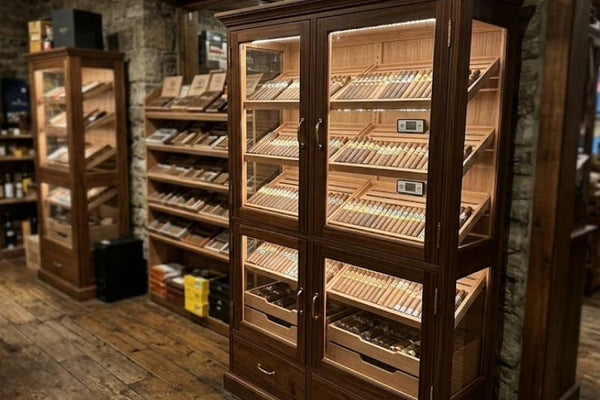
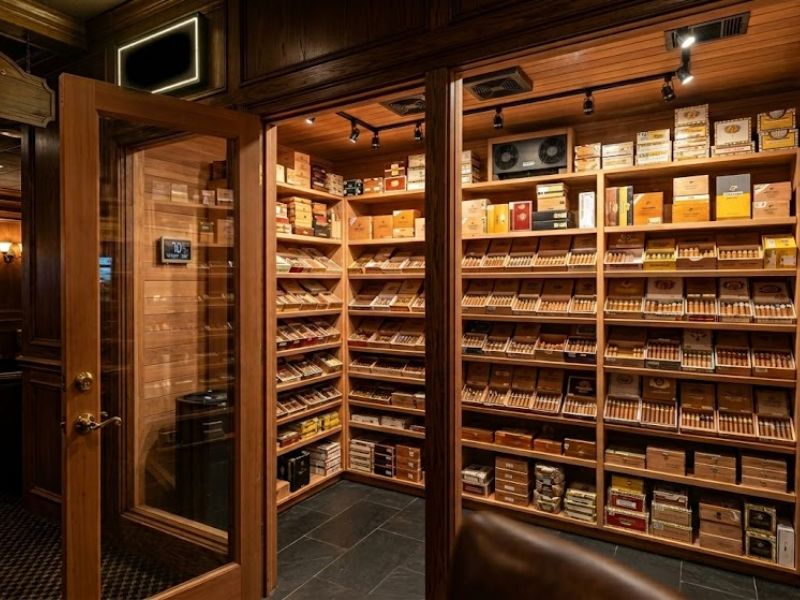
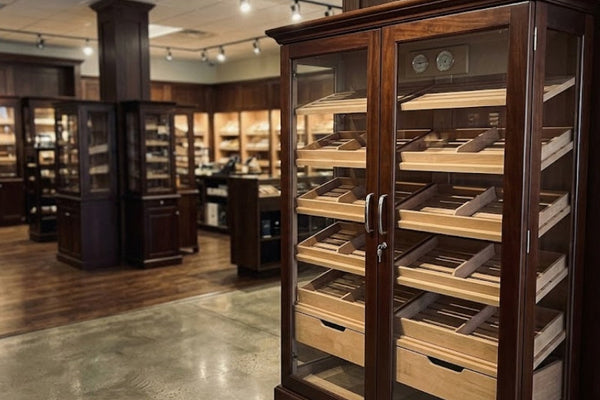
Photo Credit to our friends at Palmyra, PA at Oscar's Cigar Lounge  
Thank you for choosing our Premium Cigar Lockers!

Before choosing materials or doors, you have to understand one thing: cigars are agricultural products. They breathe. They absorb moisture. They release moisture. And they react to their environment constantly.

Designing a walk-in humidor without understanding that is like building a wine cellar without understanding cork.

The Ideal Temperature and Humidity Range

The industry standard for temperature and humidity sits between:

  • 65–72% Relative Humidity

  • 65–70°F Temperature

Most professionals aim for 68% RH and 68°F. Why? Because that balance prevents mold growth while maintaining proper cigar burn and flavor development.

Too much humidity? You’ll see swelling, tight draws, and potential mold.
Too little? Wrappers crack, oils evaporate, and flavor flattens.

The key isn’t just reaching those numbers—it’s holding them consistently. Fluctuation is the real enemy. That’s why insulation, vapor barriers, and door specs matter so much. They stabilize the microclimate.

How Improper Design Destroys Premium Cigars

Think of your walk-in humidor as a sealed envelope. If outside air constantly leaks in, your humidification system works overtime. That leads to:

  • Humidity swings

  • Overworked equipment

  • Condensation inside walls

  • Hidden mold growth

  • Warped wood shelving

  • Higher energy costs

And worst of all? Ruined cigars.

We’ve seen retailers lose entire inventories because a contractor skipped a vapor barrier or installed a standard residential door. These aren’t cosmetic issues—they’re structural failures.

That’s why Your Elegant Bar provides consultation before construction begins. It’s not about selling you a cabinet. It’s about protecting your investment long-term.  Book a design consultation now!

Build Your Custom Walk-In Humidor

We'll help you build your premium cigar shop.

Core Materials for Walk-In Humidors

Materials are where craftsmanship meets science. The wrong choice here will haunt you for years. The right one? It enhances aging, aroma, and durability.

Spanish Cedar: The Gold Standard

If walk-in humidors had royalty, Spanish Cedar would wear the crown.

It’s not technically cedar, it’s part of the mahogany family but it offers unmatched benefits:

  • Naturally regulates humidity

  • Resists mold and tobacco beetles

  • Enhances cigar aging

  • Emits that signature humidor aroma

  • Stable in high-humidity environments

Spanish Cedar absorbs excess moisture and releases it when humidity drops. It acts like a buffer, smoothing out minor fluctuations. That’s why serious collectors insist on it.

At Your Elegant Bar, our custom humidors and commercial installations prioritize Spanish Cedar interiors because performance matters more than shortcuts. Yes, it costs more. But replacing ruined cigars costs far more.

Mahogany and Alternative Hardwoods

Mahogany is another excellent choice, particularly for structural framing and exterior cabinetry. It handles humidity better than most woods and provides strength.

Other hardwoods can be used, but they must be kiln-dried and properly sealed. The interior lining, however, should always favor Spanish Cedar for direct cigar contact.

Cheap plywood? Particle board? MDF? Those are disasters waiting to happen. They absorb moisture unevenly and can release adhesives into your humidor environment. That’s not aging, that’s contamination.

Insulation: The Backbone of Climate Stability

If Spanish Cedar is the skin of your humidor, insulation is its skeleton. Without proper insulation, your humidification system becomes a losing battle against external temperature swings.

R-Value Explained for Humidor Rooms

R-value measures resistance to heat flow. The higher the R-value, the better the insulation performance.

For walk-in humidors, most professionals recommend:

  • Minimum R-19 for walls

  • R-30 or higher for ceilings

Why? Because maintaining 68°F inside while your building fluctuates seasonally requires thermal resistance. Without it, condensation forms inside wall cavities—an invisible mold factory.

Recommended Insulation Types

Closed-cell spray foam is often the top-tier option because it:

  • Provides high R-value per inch

  • Acts as an air barrier

  • Reduces moisture intrusion

Rigid foam board is another strong option when installed correctly with sealed seams.

Fiberglass batts? Risky. They allow air movement unless paired perfectly with vapor barriers.

At Your Elegant Bar, we guide clients on insulation specs before a single board goes up. Because retrofitting insulation after mold appears is expensive and avoidable.

Vapor Barriers: The Most Overlooked Critical Component

Here’s where most walk-in humidors fail.  Humidity always moves from high concentration to low concentration. Inside your humidor, humidity is intentionally high. Outside? Lower.  That means moisture constantly tries to migrate outward.

Without a proper vapor barrier, that moisture enters your wall cavities. Over time, it condenses, rots framing, and breeds mold. You won’t see it until damage is severe.

Why Moisture Control Is Non-Negotiable

A properly installed vapor barrier:

  • Prevents moisture migration

  • Protects insulation performance

  • Stops structural decay

  • Extends humidor lifespan

6-mil polyethylene sheeting is common, installed on the warm side of the insulation. Seams must be taped. Penetrations sealed. Electrical outlets accounted for.

Spray foam systems can double as vapor barriers if installed correctly, but thickness matters.

And it’s exactly why Your Elegant Bar offers expert consultation for lounges and retail cigar shops, so your investment doesn’t become a hidden moisture problem five years down the road. Book a design consultation now!

Door Specifications: Where Most Walk-In Humidors Fail

If there’s one place a walk-in humidor quietly sabotages itself, it’s the door. You can have perfect insulation, flawless vapor barriers, premium Spanish Cedar, and still lose control of your environment because of a poorly specified door.

Think about it. The door is the most used, most stressed, and most vulnerable component of the entire system. It opens dozens, sometimes hundreds, of times per day in a retail or lounge setting. Every time it opens, air exchanges. Every time it closes, it must seal completely.

A standard residential door simply won’t cut it.

Build Your Custom Walk-In Humidor

We'll help you build your premium cigar shop.

Commercial-Grade Sealing Systems

Photo Credit to our friends at Palmyra PA at Oscar's Cigar Lounge.  
Thank you for choosing our Premium Cigar Lockers!

A proper walk-in humidor door should include:

  • Heavy-duty commercial hinges

  • Magnetic or compression gaskets

  • Adjustable thresholds

  • Automatic door closers

  • Multi-point sealing systems

The goal? Airtight closure.

Even a small gap around the frame can cause your humidification system to run nonstop. That leads to inconsistent RH levels and energy waste. Worse, that constant cycling shortens the lifespan of your equipment.

When we consult with lounges and retail cigar shops, one of the first things we inspect is the door seal. In many cases, that’s the root of humidity instability.

At Your Elegant Bar, we guide clients toward door systems designed specifically for high-humidity environments. Because this isn’t just about aesthetics, it’s about engineering performance.

Glass vs. Solid Doors

Photo Credit to our friends at Chino, CA at Blazers Smoke Shop III.  
Thank you for choosing our services here at Your Elegant Bar!

Glass doors look stunning. They invite customers in. They showcase inventory. But they require insulated, double- or triple-pane tempered glass to prevent condensation.

Single-pane glass? It will sweat.

Solid wood doors provide better insulation but may lack visual appeal for retail environments. Many commercial cigar shops opt for insulated glass units with aluminum or hardwood frames designed for moisture resistance.

The right choice depends on:

  • Traffic volume

  • Climate conditions

  • Branding goals

  • Energy efficiency needs

That’s why professional guidance matters. It’s not one-size-fits-all.

Flooring Considerations for Walk-In Humidors

Flooring is often an afterthought—but it shouldn’t be.

Your walk-in humidor floor must handle:

  • High humidity

  • Frequent foot traffic

  • Temperature consistency

  • Easy cleaning

Carpet? Absolutely not. It absorbs moisture and invites mold.

Solid hardwood? Risky unless properly sealed and acclimated. It can expand and contract with humidity shifts.

The most common and effective options include:

  • Tile (porcelain or ceramic)

  • Sealed concrete

  • Luxury vinyl plank rated for moisture environments

Porcelain tile is a favorite in commercial installations because it’s non-porous, durable, and easy to maintain. Add proper subfloor insulation beneath it, and you maintain temperature stability from the ground up.

For lounges, flooring outside the humidor matters too. A clean, well-designed transition between humidor and lounge reinforces professionalism and enhances customer experience.

At Your Elegant Bar, we help clients think beyond shelves and walls—we think about the entire environment. Book a design consultation now!

Humidification Systems: Choosing the Right Technology

The humidification system is the heart of your humidor. Without it, everything else is just architecture.

There are three primary categories:

  1. Passive humidification

  2. Reservoir-based electronic systems

  3. Commercial HVAC-integrated systems

For walk-in humidors, electronic or HVAC-integrated systems are essential. Passive systems simply can’t regulate large spaces consistently.

Key considerations include:

  • Room size (cubic footage)

  • Frequency of door openings

  • Geographic climate

  • Insulation quality

  • Desired RH precision

Professional-grade humidifiers offer:

  • Digital humidity controls

  • Remote monitoring

  • Even moisture distribution

  • Automatic refill systems

But here’s what many overlook: air circulation matters just as much as humidity generation.

Without proper circulation, you’ll create microclimates. Corners may read 72% RH while center shelves read 65%. That inconsistency affects aging.

That’s why we help clients select not only humidifiers but also circulation systems designed for balanced airflow. It’s about total system performance, not just adding moisture.

Keep Every Cigar in Peak Condition

Discover the humidification systems that run as smoothly as your lounge.

Air Circulation & Clean Room Concepts

A properly designed walk-in humidor shouldn’t feel stale. It should feel fresh, aromatic, and breathable.

That’s where airflow and air purification come in.

Keeping the Humidor Clean and Smoke-Free

Many people confuse the humidor with the smoking lounge. They are not the same space.

Your humidor should be clean—free from active smoke.

Why?

Because smoke residue:

  • Settles on cigars

  • Alters flavor

  • Introduces contaminants

  • Stains interior wood

A clean humidor preserves product integrity.

This is why Your Elegant Bar emphasizes designing separate lounge ventilation systems alongside humidor construction. The humidor preserves cigars. The lounge manages smoke.

Integrating Professional Smoke Eaters

LA2-RC2-HOC filters

For lounge areas, professional-grade smoke eaters are non-negotiable. Commercial air filtration systems can remove up to 99% of airborne pollutants, including smoke particles.

We offer factory-direct commercial smoke eaters proven effective in high-traffic environments. A clean air system:

  • Protects non-smoking areas

  • Enhances customer comfort

  • Meets local compliance standards

  • Protects furnishings and finishes

When customers walk into your space and notice clean air despite active smoking, that’s when you’ve built authority.

And that’s what we help our clients achieve—a functional space that feels refined, intentional, and professionally engineered.

Breathe Easy And Smoke Better

Keep members staying longer with high-performance smoke eaters.

Designing the Lounge Around the Humidor

Your walk-in humidor is the heart. The lounge is the soul.  Designing them together creates a seamless experience.

Ask yourself:

  • Is the humidor easily accessible but thermally protected?

  • Does traffic flow prevent doors from being left open?

  • Is there a visual connection between display and lounge seating?

Successful cigar lounges design humidor placement strategically, often near entry points for retail browsing but insulated enough to maintain stability.  Seating should encourage lingering. Lighting should be warm but not heat-producing. Materials should complement the Spanish Cedar interior.

While you’re designing the layout, don’t overlook the importance of keeping essential cigar accessories within easy reach. A well-placed display of cutters, lighters, ashtrays, and travel humidors not only improves customer convenience but also increases impulse purchases and enhances the overall lounge experience. Thoughtful accessory placement turns a functional space into a complete cigar destination.

At Your Elegant Bar, we provide free consultations for lounge humidor design because we understand something critical: when your environment feels cohesive, customers stay longer. And when they stay longer, they purchase more. Book a design consultation now!

Custom Cigar Lockers & Retail Display Optimization

For clubs and upscale lounges, custom cigar lockers elevate exclusivity.

Lockers:

  • Create recurring revenue

  • Build customer loyalty

  • Provide secure aging environments

  • Enhance prestige

Spanish Cedar interiors, individual humidification controls, engraved nameplates—these details matter.

Retail display also matters. Proper shelf spacing ensures airflow. Lighting should be LED to avoid heat buildup. Clear labeling improves customer navigation.

We’ve helped retailers and hospitality venues across North America design locker systems and display layouts that balance aesthetics and airflow. Book a design consultation now!

Common Walk-In Humidor Design Mistakes to Avoid

Let’s keep this practical. Here are mistakes we frequently see:

  • Skipping vapor barriers

  • Using residential doors

  • Underestimating insulation requirements

  • Mixing smoking and storage air

  • Installing undersized humidifiers

  • Ignoring air circulation

  • Choosing improper wood materials

Each of these errors compounds over time.

The good news? They’re completely avoidable with expert planning.

Give Your Members a Reason to Stay

Increase retention with custom-crafted, secure cigar lockers.

Frequently Asked Questions

1. What is the most important component of a walk-in humidor?

The vapor barrier and insulation system are critical. Without proper moisture control and thermal stability, humidity fluctuations will occur regardless of the humidifier used.

2. Can I use regular construction materials for a humidor?

Standard materials often fail in high-humidity environments. Spanish Cedar lining, proper insulation, and sealed vapor barriers are essential for long-term performance.

3. Should the humidor and smoking lounge share air space?

No. The humidor should remain clean and smoke-free to preserve cigar integrity. The lounge should use professional smoke eaters and ventilation systems.

4. How thick should insulation be in a walk-in humidor?

Most installations require at least R-19 in walls and R-30 in ceilings, depending on climate and building conditions.

5. Why is a commercial-grade door necessary?

Walk-in humidors require airtight seals. Residential doors often allow air leakage, causing humidity instability and overworking humidification systems.

Book a Design Consultation

Whether you’re opening a new cigar lounge, upgrading a retail humidor or building custom lockers, we’re here to help.

We offer:

  • Free initial design consultations

  • Wholesale account setup

  • Custom locker systems

  • Commercial humidor solutions

  • Professional smoke eater systems

  • Factory-direct pricing

If you’re serious about building a properly functioning, clean, professional cigar environment, let’s start with a conversation. Schedule a design consultation today!

Ben Singh
Ben Singh

Ben Singh is recognized as a trusted voice in the cigar world, known for his hands-on work with humidors, humidifiers, and smoke control solutions. Since 2015, he’s helped shape how collectors, lounges, and retailers store and protect their cigars. Ben’s design input, honest reviews, and presence at major cigar shows have earned him respect from industry pros and fellow enthusiasts alike.

Leave a comment

Comments will be approved before showing up.