
Buying a commercial humidor cabinet that is too small often creates expansion challenges within months, while investing in one that is unnecessarily large can increase costs, occupy valuable floor space, and complicate humidity management. Finding the right balance requires understanding how your business operates today and how it is likely to grow over the coming years.
This guide explains how to determine the right humidor cabinet size based on business inventory, customer demand, available space, and operational goals. Rather than focusing only on stated cigar capacity, it explores the practical factors that influence purchasing decisions.
Why Humidor Cabinet Size Matters More Than Advertised Capacity

One of the biggest mistakes buyers make is selecting a humidor cabinet based solely on the advertised number of cigars it can hold. Manufacturers typically calculate capacity under ideal conditions using cigars of similar dimensions packed tightly together. Real business environments rarely resemble these ideal scenarios.
Different cigar sizes require different shelf arrangements. Boxes occupy varying amounts of space, and many businesses prefer displaying products rather than stacking them as densely as possible. Retail environments especially benefit from attractive presentation, allowing customers to browse comfortably while maintaining organized inventory.
Humidor cabinet size also affects operational efficiency. Employees need room to rotate stock, inspect products, separate new arrivals from existing inventory, and organize cigars by brand or origin. When storage becomes overcrowded, these routine tasks become more time-consuming and increase the likelihood of accidental damage.
Humidity stability is another important consideration. Humidor Cabinets with sufficient air circulation generally maintain more consistent humidity levels than cabinets filled to maximum capacity. Air needs space to move throughout the interior, ensuring every shelf receives similar environmental conditions. This consistency helps preserve wrapper quality, aroma, and flavor over extended storage periods.
Instead of treating maximum capacity as the purchasing target, many experienced buyers use it as the upper limit while planning to operate comfortably below it. This approach provides flexibility during busy seasons, promotional events, or inventory expansion.
Start with Your Business Inventory Requirements
Before comparing humidor cabinet dimensions, evaluate your current inventory strategy. Every business stores cigars differently depending on customer demand and purchasing cycles.
Ask practical questions such as:
- How many brands do you currently carry?
- How often do you receive shipments?
- Do you primarily store full boxes or individual cigars?
- Are seasonal inventory increases common?
- Will additional product categories be introduced in the near future?
These questions reveal much more than a simple cigar count. A retailer carrying fifty premium brands requires a different storage layout than a hotel lounge offering a carefully selected collection of fifteen products.
Businesses with frequent deliveries may operate efficiently using smaller cabinets because inventory turns over quickly. Operations placing larger wholesale orders every few months typically benefit from additional storage capacity that accommodates incoming shipments without disrupting existing organization.
Looking beyond current inventory also prevents premature replacement. A cabinet purchased for today's needs should ideally continue supporting operations as product lines expand.
Understanding Capacity Beyond Cigar Count

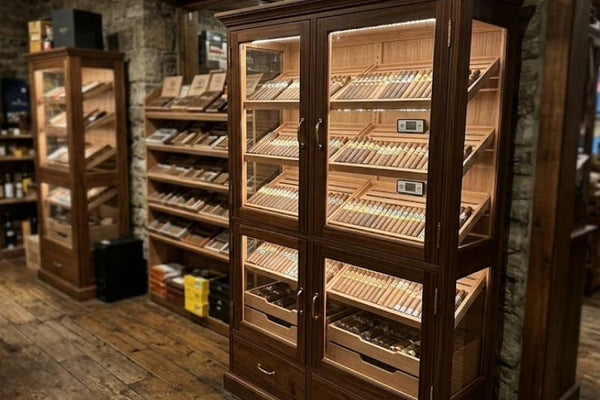
Photo credit: Oscar’s Cigar Lounge in Palmyra, PA, featuring premium cigar lockers from Your Elegant Bar
Humidor capacity should always be evaluated in terms of usable storage rather than theoretical maximums. Shelving configuration, drawer design, adjustable interiors, and box storage all influence real-world performance.
The following comparison illustrates how businesses often match cabinet sizes to their operational requirements.
| Business Type | Typical Inventory Needs | Recommended Cabinet Size |
|---|---|---|
| Boutique Retail Shop | Limited brands with curated displays | Small to medium humidor cabinet |
| Premium Cigar Lounge | Display inventory plus reserve stock | Medium to large humidor cabinet |
| Hotel or Resort | Moderate selection with consistent turnover | Medium humidor cabinet |
| Wholesale Distributor | Large boxed inventory across multiple brands | Large humidor cabinet |
| Luxury Restaurant or Private Club | Curated premium collection with presentation focus | Medium humidor cabinet |
These recommendations provide a starting point rather than strict rules. Growth expectations, available floor space, and purchasing frequency should always influence the final decision.
Matching Commercial Humidor Cabinet Size to Different Business Models

Every business serves customers differently, which means storage requirements also vary considerably. Understanding how cigars fit into daily operations helps identify the most practical humidor cabinet size.
A specialty retailer often prioritizes variety. Customers expect multiple wrapper types, countries of origin, limited editions, and premium accessories. These businesses benefit from cabinets that provide both attractive merchandising and organized storage. Adjustable shelves become especially valuable because product mixes change throughout the year.
Hospitality businesses usually have different priorities. Hotels, upscale bars, golf clubs, and restaurants generally maintain carefully selected collections instead of extensive inventories. Presentation matters as much as storage because the cabinet contributes to the atmosphere experienced by guests. A humidor cabinet that integrates seamlessly into the interior design often delivers greater value than one chosen solely for maximum capacity.
Wholesale distributors face another set of challenges. Their focus centers on efficient inventory management, receiving shipments, preparing customer orders, and maintaining organized stock. Larger humidor cabinets, especially commercial models with flexible layouts, often improve workflow while reducing handling time.
At Your Elegant Bar, we regularly work with commercial buyers whose needs extend beyond simple storage. Many businesses seek solutions that complement luxury interiors while supporting dependable humidity control and organized inventory management. The right cabinet should support daily operations without requiring constant adjustment or creating unnecessary complexity.
Leave Room for Business Growth
Many purchasing decisions focus exclusively on current inventory levels. While understandable, this approach often results in cabinets being outgrown much sooner than expected.
Business growth can occur through several channels. Existing customers may increase purchasing frequency. New product lines may expand shelf requirements. Seasonal demand can require temporary inventory increases. Some businesses also diversify into accessories, limited releases, or collector editions that deserve dedicated display space.
Choosing a cabinet with moderate expansion capacity typically costs less than replacing an undersized unit within a few years. It also minimizes operational disruption since inventory does not need to be transferred into a new storage system.
Growth planning does not necessarily mean purchasing the largest available commercial humidor cabinet. Instead, buyers should estimate realistic expansion over the next three to five years and select a size that comfortably accommodates those expectations.
This forward-looking approach often provides a stronger long-term return on investment while supporting smoother business development.
Space Planning Before You Buy

Even the ideal storage capacity loses value if the humidor cabinet does not fit naturally into the working environment. Floor space should be evaluated with daily operations in mind rather than measuring only the cabinet footprint. Employees need enough room to open doors fully, access every shelf, rotate inventory, perform cleaning, and complete maintenance without disrupting customer traffic. In retail settings, customers should also be able to browse comfortably around the display cabinet instead of feeling crowded. A cabinet positioned in a tight corner may technically fit the room, yet become inconvenient every day it is used.
Environmental conditions deserve equal attention. Cabinets perform best when placed away from direct sunlight, heating vents, exterior doors, and areas where temperature changes frequently. Stable surroundings make humidity management easier and reduce unnecessary strain on climate control systems.
Businesses should also consider future layout changes. A retail renovation, expanded product assortment, or redesigned lounge may alter how the cabinet fits within the space. Selecting dimensions that provide flexibility can help avoid expensive relocation or replacement later.
At Your Elegant Bar, we encourage buyers to evaluate the entire operating environment before choosing a cabinet because successful storage depends on more than interior capacity alone.
Shelving Flexibility Can Be More Valuable Than Extra Capacity

Many buyers naturally compare cabinet sizes, but internal organization often has a greater impact on day-to-day usability. Two cabinets with similar external dimensions may deliver very different experiences depending on shelf design, drawer placement, and storage flexibility.
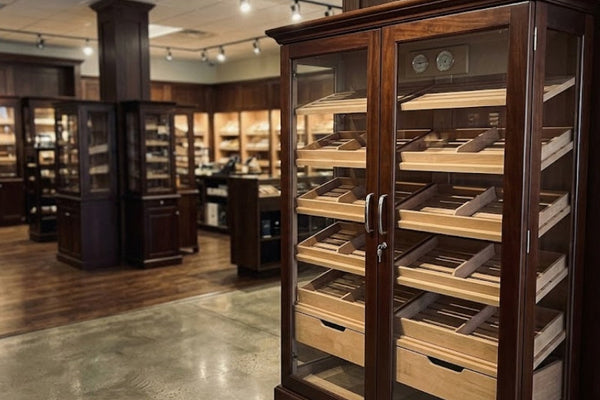
Adjustable shelving allows businesses to accommodate various box sizes, display premium cigar collections more effectively, and reorganize inventory as product assortments evolve. Fixed layouts may initially appear sufficient but can become restrictive as new brands or seasonal products are introduced.
Flexible interiors also support better inventory management. Separating products by manufacturer, country of origin, wrapper type, or price category becomes much easier when shelves can be repositioned. Employees spend less time searching for products and more time serving customers efficiently.
Organized displays also improve the buying experience because customers can browse with confidence rather than facing crowded or inconsistent presentation. Instead of paying for the highest possible cigar count, many commercial buyers receive greater long term value from cabinets that adapt to changing business needs. Practical organization frequently delivers better operational performance than maximum storage density.
Humidity Performance Changes with Cabinet Size

Humidor cabinet size influences environmental stability in ways that are sometimes overlooked during purchasing. Larger interiors require humidity systems capable of maintaining consistent conditions throughout the entire storage area.
Smaller cabinets generally reach target humidity levels more quickly, while larger units benefit from carefully designed airflow that distributes moisture evenly across multiple shelves. The objective is not simply generating humidity but maintaining consistency from top to bottom regardless of inventory arrangement.
Overfilled cabinets can restrict air circulation, creating localized dry or humid areas that affect product quality over time. Underused cabinets present different considerations because large empty spaces may require additional attention during humidity adjustment. Businesses should therefore choose a cabinet that aligns with realistic operating conditions rather than theoretical maximum capacity.
Regular monitoring remains important regardless of cabinet size, particularly in commercial environments where doors open frequently throughout the day. Reliable construction, quality sealing, and an effective humidity management system work together to preserve product condition while reducing the need for constant manual intervention.
Balancing Budget with Long-Term Value

Price understandably plays a major role in purchasing decisions, but the lowest initial investment is not always the most economical choice. Replacing an undersized cabinet after a period of business growth often costs considerably more than selecting an appropriately sized solution from the beginning.
Beyond the purchase price, businesses should consider installation, relocation, operational disruption, and the time required to transfer inventory. These indirect costs can outweigh the savings achieved by choosing a smaller cabinet initially.
A balanced purchasing strategy evaluates value over several years rather than focusing only on acquisition cost. Durable construction, dependable humidity control, quality materials, and adaptable interiors contribute to lower ownership costs because the cabinet continues supporting changing business requirements.
At Your Elegant Bar, we believe commercial buyers benefit from viewing storage as part of a broader investment in product protection, operational efficiency, and customer presentation. A cabinet that performs reliably year after year often generates stronger value than one selected purely because it carries a lower price tag.
Questions to Ask Before Making Your Final Decision
Before placing an order, decision makers should review a practical checklist that confirms the chosen cabinet matches both current operations and future objectives. Spending time on these questions can prevent costly purchasing mistakes while ensuring the cabinet continues meeting business requirements as inventory evolves.
Consider the following:
- Will this humidor cabinet comfortably support projected inventory growth over the next three to five years?
- Does the interior layout match how products will actually be stored and displayed?
- Is there enough surrounding space for daily access, maintenance, and customer interaction?
- Can shelving be adjusted as product lines expand or change?
- Will the humidity system perform effectively under normal operating conditions rather than only under ideal laboratory capacity?
These questions shift the focus from marketing specifications toward practical business use. They also encourage purchasing decisions based on operational efficiency instead of simply selecting the cabinet with the largest advertised capacity.
Choosing the Right Humidor Cabinet Size with Confidence

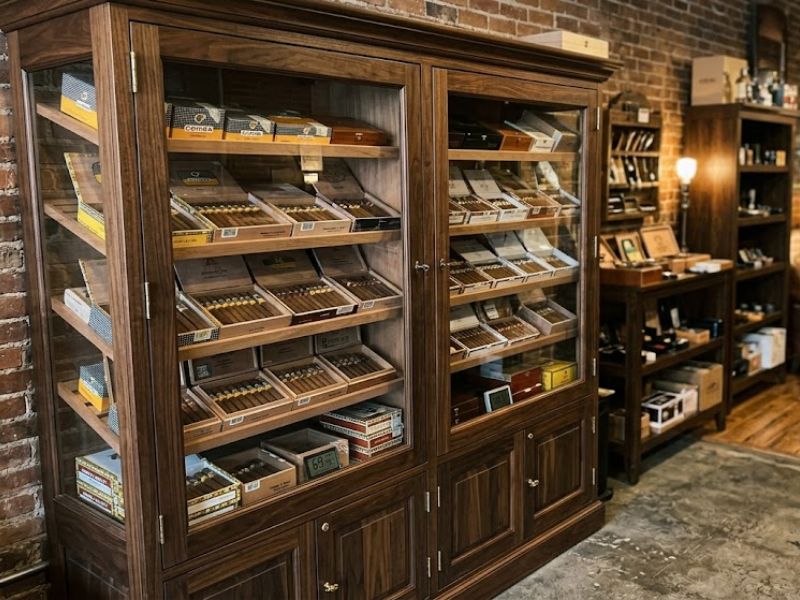
Photo credit: Oscar’s Cigar Lounge in Palmyra, PA, featuring premium cigar lockers from Your Elegant Bar
Choosing the right cigar storage cabinet starts with selecting a model that matches your inventory, available space, and long-term goals. Instead of focusing only on maximum capacity, consider shelving flexibility, humidity performance, ease of organization, and how the cabinet will fit into your daily operations. A well chosen model will protect product quality, improve workflow, and continue meeting your needs as your collection grows.
Taking the time to compare features and plan for future expansion can help you avoid costly upgrades later. The right cabinet should offer dependable performance, efficient storage, and an attractive presentation that enhances both your space and the customer experience.
At Your Elegant Bar, we have been serving customers for years with premium cigar storage solutions and expert knowledge. If you are looking to upgrade, explore our collection of cigar humidor cabinets designed to suit a wide range of storage needs. Not only that, but we also offer humidifiers, air purifiers and smoke eaters, and essential cigar accessoriess to help complete your setup. Choose Your Elegant Bar for quality products you can trust and everything you need to create the ideal cigar environment.
Need help choosing the right cigar storage cabinet for your space and inventory? Contact us today, and we'll help you find a storage solution that combines reliable performance, lasting quality, and an elegant presentation.