
by B Singh March 25, 2026 12 min read

Summary:

  • This article explains why buying a smoke eater alone is not enough for effective cigar lounge smoke control.
  • Key points include air pressure dynamics, CFM calculations, and why a systems-based approach to ventilation design outperforms single-unit solutions.
  • Readers will learn the proven principles of smoke control system design that go beyond equipment purchases.

A cigar lounge without proper smoke control doesn’t fail immediately. It gradually becomes uncomfortable in ways that are easy to miss at first but hard to ignore over time. Guests may not complain directly, yet they shorten their visits, avoid certain areas, and slowly stop returning. Staff feel the effects even more through constant exposure. The issue is rarely the cigars or the furniture; it’s the absence of a properly designed system that manages how air and smoke move through the space. 

Your Elegant Bar has been helping cigar lounges, retailers, and hospitality spaces since 2016, designing and building functional cigar environments. Over the years, we’ve helped clients select the right smoke eaters, plan airflow, integrate HVAC considerations, and align humidor placement with overall lounge design. We focus on creating integrated systems so clients can avoid common issues such as uneven air quality, dead zones, and underperforming setups, resulting in cleaner, more comfortable spaces.

Breathe Cleaner, Enjoy Better

Shop Smoke Eaters and Air Purifiers for Homes, Lounges & Shops

Smoke Behavior: What You’re Actually Dealing With

Cigar smoke behaves differently from what most people expect, and this misunderstanding is where many designs fall apart. It’s heavier, oilier, and more persistent than cigarette smoke. It doesn’t just rise and disappear; it spreads, cools, and lingers in layers depending on how air is moving in the room. If airflow is inconsistent, smoke settles into pockets that no single unit can effectively clean.

Think of smoke less like a straight upward stream and more like a slow-moving fog. It expands outward from the source, follows air currents, and fills low-pressure zones. In a lounge setting, this means smoke doesn’t just collect near the ceiling; it often stays right in the breathing zone, especially when airflow is weak or disrupted.

There are a few critical behaviors that matter when designing your system:

  • Smoke follows airflow, not just heat

  • It accumulates in corners and dead zones

  • It can be pushed back down by conflicting air currents

  • It spreads horizontally before rising in many environments

If you ignore these behaviors, you end up designing for assumptions instead of reality. That’s why some lounges feel uneven—one chair feels fine, the next feels heavy. It’s not random. It’s airflow inconsistency.

When we work with clients at Your Elegant Bar, we focus on identifying how smoke will actually move in their specific space. Not in theory, but based on layout, ceiling height, and usage patterns. That understanding becomes the foundation for everything else. Without it, every other decision is guesswork. Book a design consultation now!

Why a Smoke Eater Alone Will Always Fall Short

Air Quality Engineering Smoke Eater Smokemaster C-12 – Self-Contained Air Cleaning System

Buying a high-end smoke eater without a system plan is like installing a powerful engine in a car with no transmission—it has capability, but no direction. The unit itself isn’t the problem. The problem is expecting it to compensate for poor airflow design.

Smoke eaters only clean the air that passes through them. If airflow isn’t guiding smoke into the unit, it simply won’t perform as expected. This is why two lounges can use the exact same model and get completely different results.

Here’s where most setups go wrong:

Mistake What Happens Result
Single unit reliance Limited coverage area Uneven air quality
Poor placement Smoke bypasses intake Lingering haze
No airflow planning Random circulation Inconsistent experience
Oversized room vs unit Underpowered system Constant buildup


Another issue is overestimating square footage ratings. Those ratings assume ideal airflow conditions, which almost never exist in real lounges. Furniture, partitions, and human movement all disrupt airflow in ways those specs don’t account for.

Airflow Design: The Part Most People Skip

Airflow is the piece that quietly determines whether your entire setup works or fails. It’s not visible, which is why it’s often overlooked, but it controls everything. Without intentional airflow, smoke has no reason to move toward filtration.

A proper system creates a controlled path:

  • Fresh air enters the space

  • Air moves consistently across occupied zones

  • Smoke is carried toward filtration units

  • Cleaned air is recirculated or exhausted

Simple in concept, but execution is where things break down.

One of the most common issues is conflicting airflow. For example, an HVAC vent pushes air one direction while a smoke eater pulls in another. Instead of guiding smoke, this creates turbulence. Smoke ends up swirling and spreading rather than being removed.

Another issue is dead zones—areas where air barely moves. These are typically:

  • Corners

  • Areas behind large furniture

  • Sections with poor vent coverage

  • Low-traffic seating areas

If you’ve ever noticed certain seats always feeling “heavier,” that’s a dead zone problem.

At Your Elegant Bar, we approach airflow like a map. We look at how air enters, where it naturally wants to go, and where it gets stuck. Then we design around that instead of fighting it. Sometimes small adjustments, like redirecting a vent or shifting a unit a few feet, make a bigger impact than adding more equipment. Book a design consultation now!

Ceiling Height and Its Impact on Smoke Control

Ceiling height directly affects how smoke behaves and how hard your system has to work. Higher ceilings increase the total air volume, which slows down how quickly smoke reaches filtration units. This might sound like an advantage, but in practice, it often leads to smoke spreading out and lingering longer before being captured. If units are mounted too high or airflow isn’t properly directed, smoke can remain suspended in the breathing zone instead of being pulled out efficiently.

Lower ceilings create the opposite problem. Smoke has less space to disperse, so it builds up faster, especially in busy lounges. Without strong, consistent airflow, the space can feel saturated quickly. In these environments, capture needs to happen faster and closer to the source, otherwise the entire room becomes uniformly dense.

Placement needs to adjust based on this:

  • High ceilings: Units should be positioned closer to where smoke is produced, not just mounted overhead. Airflow needs to guide smoke upward rather than waiting for it to rise naturally.

  • Low ceilings: Faster air exchange and tighter placement help prevent rapid buildup. Units should be spaced to avoid overwhelming any single area.

At Your Elegant Bar, we factor ceiling height into every layout we review because it directly changes how airflow should be designed and how equipment should be positioned. Getting this wrong leads to systems that feel inconsistent no matter how powerful the units are.  Book a design consultation now!

Strategic Placement: Where Performance Is Won or Lost

Placement is where design becomes real. You can have the right equipment and still get poor results if it’s installed without strategy. This is one of the most common issues we see when clients come to us after trying to solve the problem on their own.

Smoke eaters should never be placed randomly or purely for visual symmetry. They need to sit where smoke actually travels.

Effective placement usually follows a few principles:

  • Position units along natural airflow paths

  • Keep them within reach of primary smoking zones

  • Avoid placing them too high where smoke has already dispersed

  • Ensure overlapping coverage in larger spaces

Spacing is critical. Too far apart, and you create gaps. Too close, and you waste capacity. The goal is balance, not concentration.

There’s also a practical side: noise and aesthetics. A loud unit near seating can ruin the experience, no matter how effective it is. The best setups feel invisible. Guests don’t notice the system; they just notice that the air feels clean.

Breathe Cleaner, Enjoy Better

Shop Smoke Eaters and Air Purifiers for Homes, Lounges & Shops

Integrating HVAC Without Letting It Work Against You

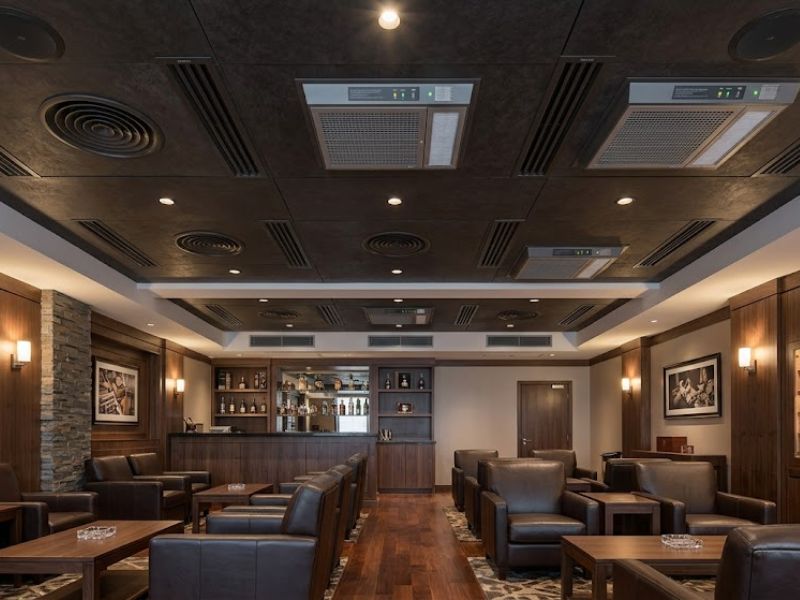
HVAC systems are often treated as separate from smoke control, but in reality, they’re tightly connected. Your HVAC system is constantly moving air—whether you account for it or not. If it’s not aligned with your smoke control design, it will work against you.

Strong supply vents can push smoke away from filtration units, while poorly placed returns can drag smoke across seating areas before it’s removed. This creates inconsistency that no amount of filtration power can fix.

Key integration points include:

  • Aligning vent direction with airflow goals

  • Avoiding direct conflict between vents and smoke eaters

  • Balancing air pressure to prevent stagnation

  • Ensuring return vents support smoke removal, not redistribution

In many cases, the solution isn’t replacing HVAC—it’s adjusting it. Small changes in vent direction or airflow balance can dramatically improve results.

Your Elegant Bar evaluates how HVAC interacts with your layout and adjusts airflow so it supports smoke control, and we can help you apply this to your space. We’ve helped clients align vents and equipment, so air moves properly instead of recirculating smoke. If your system feels unbalanced, we can assess it with you in a consultation. Book a design consultation now!

Air Purification vs Smoke Eaters: Understanding the Difference

Air purifiers and smoke eaters are often treated as interchangeable, but they serve different roles within a cigar lounge environment. A smoke eater is designed specifically to capture and filter cigar smoke at the source using high-efficiency filtration and active air movement. It’s built to handle dense, particulate-heavy air directly in the lounge where smoking occurs.

In contrast, air purifiers are generally designed for lighter airborne contaminants such as dust, allergens, and odors, and are typically more effective in maintaining baseline air quality rather than handling concentrated smoke loads.

The key difference comes down to capacity and purpose. Smoke eaters are engineered for high-volume smoke environments, while air purifiers are supplemental tools that can help polish air quality but cannot replace a properly designed smoke control system. In a well-designed lounge, both can play a role, but only when used correctly and in the right context.

Zoning Your Lounge for Consistent Air Quality

Not every part of a cigar lounge behaves the same, so treating the entire space as one uniform environment is a mistake. Some areas carry heavier smoke loads—typically where people sit longer, smoke more frequently, or gather in groups. Other areas, like walkways or bar sections, experience more movement and less accumulation. If your system doesn’t account for these differences, you end up overcorrecting in some places and underperforming in others.

Zoning allows you to break the lounge into functional sections and design airflow and filtration accordingly. Instead of forcing one system to do everything, you create targeted control. This leads to a more consistent experience across the entire space, rather than pockets of clean air mixed with problem areas.

A practical zoning approach often looks like this:

Zone Type Characteristics System Focus
High-density seating Long stays, frequent smoking Strong filtration + directed airflow
Bar or social areas Constant movement Balanced airflow, moderate filtration
Transitional spaces Walkways, entrances Air guidance, minimal buildup
Private or VIP rooms Enclosed environments Dedicated units + controlled airflow


Transactional areas like entrances, walkways, and the bar sit along natural airflow paths and have higher air turnover, so smoke buildup is minimal and requires less aggressive control. These same areas are ideal for placing cigar accessories like lighters, cutters, ashtrays and even travel humidors because they stay accessible without interfering with heavier smoke zones or disrupting airflow.

At Your Elegant Bar, we walk clients through how their cigar lounge will be used in real-world conditions, not just how it looks on a floor plan. That distinction matters. A visually perfect layout can still fail if it ignores how people behave inside the space. Zoning bridges that gap and brings practical control into the design. Book a design consultation now!

The Overlooked Connection Between Humidors and Air Quality

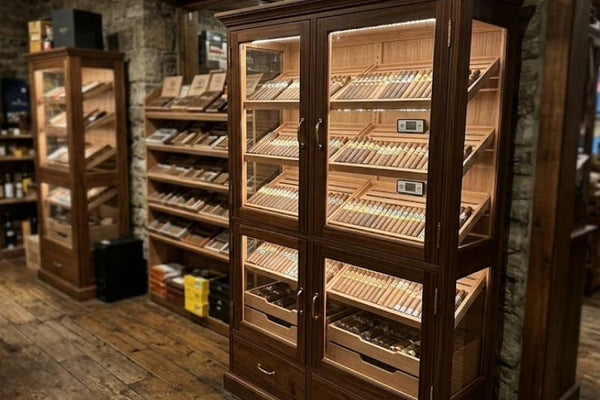
Photo Credit to our friends at Palmyra, PA at Oscar's Cigar Lounge
Thank you for choosing our Premium Cigar Lockers!

Most people separate humidors, specifically walk-in humidors, from smoke control, but in a working lounge, they’re connected whether you plan for it or not. A walk-in humidor isn’t just a storage feature; it’s a controlled environment that can be affected by the air around it. If smoke infiltrates that space, it disrupts both cigar preservation and overall air quality.

A poorly sealed humidor will allow smoke to seep in, especially if there’s a pressure imbalance between the lounge and the humidor. Over time, this impacts flavor integrity, aroma, and even the aging process of your cigars. It also creates an additional source of odor that can bleed back into the lounge.

Proper integration comes down to a few key details:

  • Ensuring airtight sealing on doors and structure

  • Maintaining slight positive pressure inside the humidor

  • Preventing direct airflow from smoke-heavy zones into the humidor entrance

  • Coordinating placement with overall lounge airflow design

This doesn’t require overcomplicating your humidor build; it just requires awareness during planning. If you’ve already invested in quality materials like Spanish Cedar and proper humidification, it makes no sense to let smoke contamination undermine that.

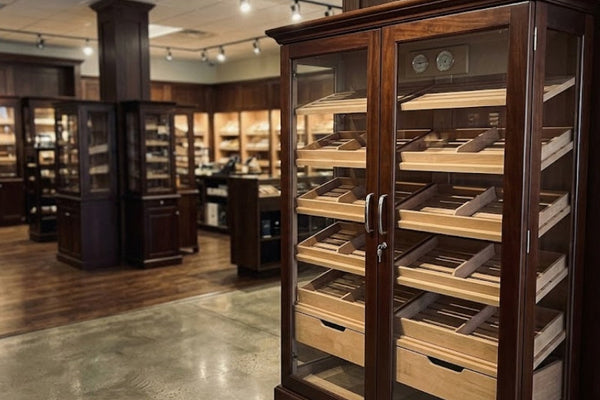
Cabinet humidors follow the same principle, even on a smaller scale. Their internal environment still depends on a stable balance between humidity control and surrounding air conditions, which is why a properly calibrated humidification system is essential. If a cabinet humidor is placed in an area with inconsistent airflow or exposed to smoke-heavy circulation, it can require constant adjustments to maintain proper humidity levels.

When positioned thoughtfully and supported by a reliable humidification system, cabinet humidors can maintain consistent internal conditions while remaining insulated from fluctuations caused by the lounge environment.

Breathe Cleaner, Enjoy Better

Shop Smoke Eaters and Air Purifiers for Homes, Lounges & Shops

Maintenance Planning: Filters, Upkeep, and System Longevity

Even a well-designed smoke control system will lose effectiveness without consistent maintenance. Filters are doing the heavy lifting, and in an active cigar lounge, they accumulate particulate quickly. As filters load up, airflow drops, and the system’s ability to capture smoke decreases. This doesn’t happen all at once—it’s gradual, which is why it often goes unnoticed until the air starts feeling heavier.

In most active lounges, filters need regular attention:

  • Pre-filters: Checked frequently and replaced as needed depending on usage

  • Main filters (HEPA or equivalent): Replaced on a scheduled basis based on manufacturer guidelines and actual load

  • Carbon filters: Monitored for odor control performance, not just airflow

When filters clog, units don’t just become less effective—they can start recirculating partially cleaned air, which defeats the purpose of the system. This is one of the most common reasons lounges experience declining air quality over time despite having good equipment.

Maintenance should be treated as part of the operating cost, not an afterthought. Budgeting for replacement filters and routine checks ensures the system continues performing as designed.

Your Elegant Bar helps clients plan for this upfront by matching equipment to expected usage levels and outlining realistic maintenance schedules. A system that’s maintained properly will consistently perform, while one that’s neglected will fall short regardless of how it was designed. Book a design consultation now!

Common Mistakes That Quietly Ruin Air Quality

Most air quality issues don’t come from obvious failures; they come from small missteps that compound over time. These are the kinds of problems that don’t show up on day one but gradually affect how the space feels.

One of the biggest mistakes is undersizing the system. Many lounge owners rely on manufacturer coverage estimates without accounting for real-world conditions. Those numbers rarely factor in occupancy levels, furniture layout, or airflow disruption. The result is a system that’s always slightly behind the demand.

Another issue is poor coordination between components. Smoke eaters, HVAC, and layout decisions are often made separately, leading to systems that compete instead of cooperating. This creates airflow conflicts that spread smoke rather than remove it.

Maintenance is another weak point. Filters clog, performance drops, and airflow weakens, but because the decline is gradual, it often goes unnoticed until the space feels noticeably heavier.

Here’s a quick breakdown of what to watch for:

  • Relying solely on square footage ratings

  • Installing units for symmetry instead of function

  • Ignoring airflow direction entirely

  • Skipping routine filter replacement

  • Overlooking how furniture blocks air movement

At Your Elegant Bar, we’ve helped clients recover from all of these situations without starting from scratch. In most cases, the fix is a strategic adjustment, not replacement. Over the years, we’ve guided lounges in correcting placement and sizing so their systems perform consistently. If your space has uneven air quality, we can review it with you during a consultation. Book a design consultation now!

Frequently Asked Questions

1. How do I know if my current smoke control system is underperforming?

If certain areas feel heavier than others, or if the air never quite feels clean even with units running, your system likely has airflow or placement issues rather than a lack of power.

2. Is it better to have multiple smaller units or one large unit?

In most cases, multiple properly placed units perform better because they create even coverage and support consistent airflow across the entire lounge.

3. Can poor layout design affect smoke control?

Yes. Furniture placement, ceiling height, and room division all influence how air moves. Even a strong system can struggle in a poorly arranged space.

4. Do I need to redesign my entire lounge to fix air quality?

Not usually. Many issues can be resolved by adjusting airflow, repositioning units, or improving system coordination rather than starting over.

5. How early should smoke control be planned in a new lounge?

As early as possible. It should be considered alongside layout and HVAC design, not added afterward as a separate solution.

Breathe Cleaner, Enjoy Better

Shop Smoke Eaters and Air Purifiers for Homes, Lounges & Shops

Schedule a Design & Wholesale Consultation

If you’re trying to get smoke under control in your cigar lounge, the challenge usually isn’t just choosing equipment. It’s choosing the right combination of systems that actually work together in your specific space. 

That’s where we step in. Your Elegant Bar helps you evaluate your layout, airflow, HVAC interaction, and humidor placement so the entire environment functions as one coordinated system rather than disconnected parts.

If you’re building a new lounge or fixing an existing one, having a clear design plan upfront can save significant time, cost, and frustration. We’ve worked with cigar lounges, retailers, and hospitality spaces to help them create environments that stay consistently clean, comfortable, and operationally efficient.

Book your design consultation today!

Ben Singh
Ben Singh

Ben Singh is recognized as a trusted voice in the cigar world, known for his hands-on work with humidors, humidifiers, and smoke control solutions. Since 2015, he’s helped shape how collectors, lounges, and retailers store and protect their cigars. Ben’s design input, honest reviews, and presence at major cigar shows have earned him respect from industry pros and fellow enthusiasts alike.

Leave a comment

Comments will be approved before showing up.

A cigar humidor cabinet in a cigar lounge

6 Best Commercial Cigar Humidor Sellers in the USA (2026 Guide)

Looking for the best commercial cigar humidor sellers in the USA for 2026? Compare top suppliers by climate control, customization, warranty support, and long-term reliability for cigar lounges, retailers, and collectors.

Read More
A cigar humidor in a cigar shop

15 Best Commercial Humidors for Cigar Shops and Lounges

Choosing the right commercial cigar humidor can define how a shop or lounge presents, preserves, and sells its cigar collection. This guide compares top cabinet humidors built for retail performance, storage capacity, and premium display value.

Read More
Humidors for sale

Cigar Humidor for Sale: 10 Things to Look for Before You Buy

Looking for a cigar humidor for sale? Learn what your business should consider before buying, including capacity, humidity control, Spanish cedar construction, security features, and commercial storage requirements.

Read More