
by B Singh April 06, 2026 13 min read

Summary:

  • This article helps cigar lounge owners calculate the number of smoke eaters needed for their space.
  • Key points include why square footage alone is insufficient, how to use air changes per hour (ACH) as the key sizing metric, and how occupancy levels affect requirements.
  • Readers will learn a practical formula for right-sizing their air purification system for any lounge configuration.

Getting smoke control wrong in a cigar lounge isn’t a minor inconvenience—it directly affects how long people stay, how comfortable they feel, and whether they come back. We'll break down exactly how many smoke eaters you need by focusing on what actually matters: square footage and occupancy. You’ll see how to size your system properly, avoid common mistakes, and create an environment where smoke is controlled instead of overwhelming the space.

Since 2016, we’ve worked alongside cigar shop owners, lounge operators, and hospitality spaces across North America, helping turn ideas into fully functional environments that actually perform day to day. Your Elegant Bar has been part of everything from small boutique lounges to large commercial builds, helping shape spaces that feel refined, balanced, and comfortable the moment you walk in. That same hands-on experience is what informs how we approach every setup, including the kind of decisions you’re making here.

Why Square Footage Alone Isn’t Enough

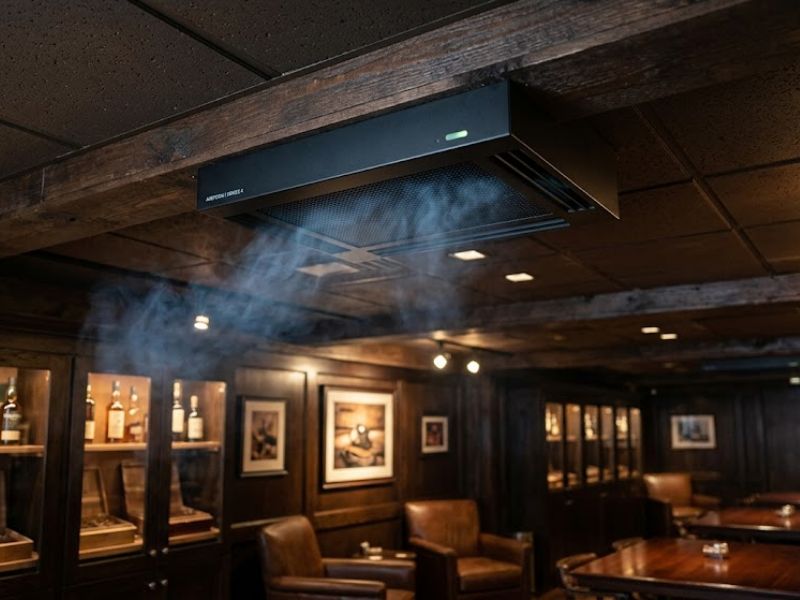
Your Elegant Bar Air Purifier LAFC-RC2-OC Flush to Ceiling Smoke Eater

A common mistake is sizing smoke eaters purely based on square footage. On paper, it seems logical. If a unit covers 1,000 square feet, then a 2,000 square foot lounge should need two units. In reality, that rarely works as expected.

Breathe Cleaner, Enjoy Better

Shop Smoke Eaters and Air Purifiers for Homes, Lounges & Shops

Square footage doesn’t account for how smoke behaves. Cigars produce dense, lingering smoke that doesn’t dissipate evenly. It collects in certain zones, especially in seating areas, corners, and near ceilings. If you only size based on area, you’ll often end up with dead zones where the air feels noticeably worse.

Occupancy changes everything. A 1,500 square foot lounge with five people smoking occasionally is completely different from the same space hosting 25 active smokers. The air exchange demand increases dramatically with each additional cigar lit. That’s why two lounges of identical size can require completely different smoke eater setups.

Ceiling height also plays a role. Higher ceilings give smoke more volume to disperse into, which can help temporarily—but it also means your filtration system has more air to cycle through. Without proper circulation and unit placement, smoke will stratify and linger overhead before slowly settling back down.

Furniture layout and room design matter too. Large sectional seating, partitions, or bar setups can block airflow and create pockets where smoke accumulates. This is where experience comes in, understanding how air actually moves in a lounge environment, not just what the spec sheet says.

When we work with clients here at Your Elegant Bar, we don’t stop at square footage. We look at how the space will be used, how many people will realistically occupy it, and how the layout affects airflow. That’s how you avoid underbuilding your system and dealing with complaints later. Book a design consultation now!

Understanding Air Changes Per Hour (ACH) for Cigar Lounges

If you want a more accurate way to size smoke eaters, focus on air changes per hour (ACH). This is the number of times the total volume of air in a room is filtered or replaced in one hour. It’s the standard metric professionals use when designing smoke control systems.

For designing cigar lounges, the target ACH is significantly higher than typical commercial spaces. Offices might operate comfortably at 2–4 ACH. Cigar lounges often require 8–15 ACH depending on usage. Heavy-smoking environments push even higher.

Here’s why that matters. If your lounge contains 10,000 cubic feet of air, and your system provides 10 ACH, that means 100,000 cubic feet of air is being filtered every hour. That’s the level of circulation needed to keep cigar smoke under control in a busy environment.

Most commercial smoke eaters are rated in CFM (cubic feet per minute). Converting that into ACH helps you understand how effective your system will be. For example, a unit rated at 2,000 CFM processes 120,000 cubic feet per hour. In a 10,000 cubic foot room, that equals 12 ACH, solid performance for a moderately busy lounge.

The challenge is that these numbers assume perfect distribution, which never exists in real-world settings. That’s why relying on a single large unit is often less effective than using multiple strategically placed units. You’re not just trying to hit a number; you’re trying to evenly clean the air throughout the space.

We often advise clients here at Your Elegant Bar to think in terms of layered filtration rather than a single solution. Multiple units working together create better airflow patterns and eliminate pockets of stagnant smoke. It’s a more balanced approach and leads to a noticeably cleaner environment. Book a design consultation now!

General Sizing Guidelines by Square Footage

While every space is different, there are practical baseline ranges you can use to estimate how many smoke eaters you’ll need. These aren’t rigid rules, but they give you a strong starting point before refining based on occupancy and layout.


Lounge Size Light Use (Low Occupancy) Moderate Use Heavy Use (Full Lounge)
Up to 500 sq ft 1 unit 1–2 units 2 units
500–1,000 sq ft 1–2 units 2 units 2–3 units
1,000–2,000 sq ft 2 units 2–3 units 3–4 units
2,000–3,000 sq ft 2–3 units 3–4 units 4–5 units


These estimates assume commercial-grade smoke eaters with strong CFM ratings, not residential air purifiers. The difference matters. Consumer units are not designed to handle continuous cigar smoke and will underperform quickly in a lounge setting.

Notice how the number of units increases with occupancy, not just size. That’s intentional. A packed 1,500 square foot lounge can easily require more filtration than a half-empty 2,500 square foot space.

Another thing to keep in mind is redundancy. Running multiple units gives you flexibility. If one unit goes down or needs maintenance, the system still functions. With a single oversized unit, you don’t have that margin.

At Your Elegant Bar, we often recommend slightly overbuilding rather than cutting it close. Not dramatically, but enough to ensure consistent performance during peak hours. Customers notice clean air immediately, even if they can’t explain why. Book a design consultation now!

Sizing by Occupancy: The Real Game Changer

Occupancy is where most sizing decisions either succeed or fail. Each active smoker adds a measurable load to your air filtration system. Cigars burn longer than cigarettes and produce thicker smoke, which means the system has to work harder for longer periods.

A good rule of thumb is to estimate how many people will be smoking at peak capacity, not average use. If your lounge seats 30 but typically hosts 15, you still design for 30. That’s when your system will be tested.

You can think of it this way: every smoker increases the required CFM. While there’s no perfect universal formula, many experienced designers loosely account for an additional 300–500 CFM per active smoker in enclosed environments. That adds up quickly.

For example, a lounge with 20 active smokers may require an additional 6,000–10,000 CFM on top of baseline air circulation. That’s why smaller lounges can still need multiple units if they’re densely occupied.

This is also where layout planning ties in. If most smokers gather in one area, that zone needs more concentrated filtration. Spreading units evenly across the room might look balanced on paper but fail in practice if usage is uneven.

Breathe Cleaner, Enjoy Better

Shop Smoke Eaters and Air Purifiers for Homes, Lounges & Shops

Placement Strategy: Where You Put Units Matters

Even the best smoke eaters won’t perform if they’re placed poorly. Positioning directly affects how efficiently smoke is captured and filtered. This is where many setups fall short—they have enough capacity on paper, but poor placement creates uneven results.

Smoke rises first, then spreads and settles. That means units should be positioned to intercept smoke as it moves, not after it has already filled the room. Placing units near seating areas, especially where smokers are concentrated, improves capture efficiency immediately.

Wall placement versus central placement also matters. Wall-mounted or perimeter units work well when spaced evenly, but central ceiling-mounted units can sometimes provide better overall circulation in open layouts. The right choice depends on the room design.

Airflow direction is another factor. Units should complement each other, not compete. If two units are pulling air in opposite directions, you can create turbulence that reduces efficiency. Instead, think of airflow as a coordinated system guiding smoke toward filtration points.

It’s also worth considering how accessories and surfaces are used throughout the lounge. Items like ashtrays, cutters, and lighters naturally define where people gather and smoke more frequently. These high-use areas tend to produce more concentrated smoke, which makes them priority zones when positioning smoke eaters for effective capture.

At Your Elegant Bar, we help map this out during consultations so clients avoid trial-and-error after installation. It saves time, money, and frustration. This is one of those areas where experience makes a noticeable difference. We’ve worked with lounges where simply repositioning existing units improved air quality without adding new equipment. It’s not always about more—it’s about smarter placement. Book a design consultation now!

Single Unit vs Multiple Units: What Actually Works Better

It’s tempting to simplify the decision and install one large, high-capacity smoke eater. On paper, it checks the boxes—strong CFM, wide coverage, fewer installation points. In practice, this approach often underdelivers in cigar lounges.

A single unit creates a centralized pull of air, which means areas closer to the unit get cleaned faster while distant zones lag behind. Smoke doesn’t move in straight lines; it drifts, pools, and gets trapped in pockets. With only one unit, you’re relying on natural air movement to bring contaminated air back to that single filtration point. That delay is what causes visible haze and lingering odor.

Multiple units solve this by distributing filtration across the entire space. Instead of one strong pull, you create a network of smaller, coordinated airflow zones. Each unit handles a portion of the load, capturing smoke closer to its source. This reduces buildup and keeps the air consistently cleaner throughout the room.

There’s also a performance advantage during peak hours. When occupancy spikes, multiple units can handle the increased load more evenly. A single unit, no matter how powerful, has a limit. Once it’s overwhelmed, air quality drops quickly. With multiple units, the system has built-in resilience.

Maintenance is another factor. Filters need to be replaced, and units occasionally require servicing. If you’re relying on one unit, downtime becomes a problem. With multiple units, you can maintain one while the others continue operating, keeping your lounge functional.

When to Upgrade vs Add More Units

Adding more units makes sense when your current system is performing well overall but struggling in specific areas. If smoke tends to linger in certain sections, like corners, bar seating, or high-traffic zones, the issue is uneven coverage, not lack of total power. In this case, adding one or two properly placed smoke eaters helps capture smoke closer to the source and evens out airflow across the space. This approach is especially effective in lounges with segmented layouts where usage isn’t evenly distributed.

Upgrading to higher-capacity units is the better choice when the entire lounge feels affected, particularly during peak occupancy. If the air becomes consistently hazy or heavy across the room, your system likely doesn’t have enough total CFM to keep up. This often happens when systems are sized for lighter use or built with residential-grade purifiers that can’t handle continuous cigar smoke. In these situations, replacing existing units with fewer, more powerful commercial-grade smoke eaters increases overall air turnover and restores control.

There are also clear signs your current equipment is no longer keeping up. Reduced airflow, filters clogging faster than expected, and declining performance over time all point to inefficiency. Older units may still run, but they lose effectiveness under constant load. If your issue is localized smoke buildup, expand your system. If it’s consistent air quality across the entire lounge, increase capacity. Making the right call here prevents wasted spend and keeps your air quality consistent when it matters most.

Common Mistakes That Lead to Poor Smoke Control

Most smoke control issues don’t come from bad equipment; they come from poor planning. The same common mistakes show up repeatedly, especially in new lounges trying to balance cost and performance.

One of the biggest issues is underestimating demand. It’s easy to size a system for average use, but lounges aren’t judged during slow hours. They’re judged when they’re full. If your system can’t handle peak occupancy, customers notice immediately. The air feels heavy, visibility drops slightly, and the experience suffers.

Another common mistake is relying on residential-grade air purifiers. These units aren’t designed for continuous cigar smoke. They may work temporarily, but filters clog quickly, airflow drops, and performance declines. Commercial-grade smoke eaters are built for this environment and hold up under sustained use.

Poor placement is just as damaging. Units installed too high, too far from seating areas, or clustered in one section leave gaps in coverage. Smoke doesn’t get captured efficiently, and you end up with uneven air quality across the room.

Ignoring airflow dynamics is another issue. HVAC systems, ceiling fans, and open doors all influence how smoke moves. If your smoke eaters aren’t aligned with these factors, they can end up working against the natural airflow instead of with it.

These are the kinds of issues that are much easier to prevent than fix after the fact. At Your Elegant Bar, we’ve worked with many lounge owners who came to us after running into these exact problems, and in most cases, the solution came down to correcting sizing, placement, or equipment choices early on. Having a clear plan from the start makes a noticeable difference in how the space performs long term. Book a design consultation now!

How Smoke Eaters Fit Into Your Overall Lounge Design

Smoke eaters don’t operate in isolation—they’re part of a larger system that includes layout, ventilation, and humidor design. If these elements aren’t aligned, even a well-sized smoke eater setup can fall short.

Your lounge layout influences how people gather and where smoke concentrates. Seating clusters, bar areas, and private sections all create different airflow patterns. If your smoke control system doesn’t account for this, you’ll end up with hotspots where air quality drops.

A well-performing lounge isn’t just about air filtration. Humidifiers and humidification systems need to work alongside your smoke control setup to maintain consistent conditions without fighting airflow. When these systems are aligned, you avoid fluctuations that can impact both air quality and cigar preservation, especially in spaces where the lounge and humidor areas are closely connected.

Walk-in humidors, cabinet humidors, and other storage areas also play a role. While they’re typically separated from the main lounge, airflow between spaces needs to be controlled. You don’t want smoke drifting into storage zones with cigar cabinet humidors where it can affect product quality or create odor issues.

HVAC integration is another layer. Smoke eaters handle filtration, but your HVAC system contributes to air movement and temperature control. When these systems complement each other, you get smoother circulation and better overall performance.

Practical Example: Applying Sizing to a Cigar Lounge

Let’s break this down with a practical example. Say you’re designing a 1,800 square foot cigar lounge with 10-foot ceilings. That gives you 18,000 cubic feet of air. You expect peak occupancy of around 20 active smokers.

If you target 10–12 ACH, you’ll need to filter roughly 180,000 to 216,000 cubic feet of air per hour. That translates to about 3,000–3,600 CFM total system capacity. Now factor in occupancy. With 20 smokers, you’re adding a significant smoke load. To maintain consistent air quality, you’d likely push toward the higher end of that range or slightly above it.

Instead of installing one 3,500 CFM unit, a better approach would be three units in the 1,200–1,500 CFM range. This allows you to distribute filtration across the space, one near the main seating area, one near the bar, and one covering secondary seating.

This setup captures smoke closer to where it’s produced and maintains more even air quality. It also gives you flexibility if the layout changes or if certain areas become more heavily used over time.

In a setup like this, you’re not just planning for airflow—you’re planning for how the space is actually used. Travel humidors, personal accessories, and table setups all influence where people sit and how long they stay. These small details often shift smoking patterns, which in turn affects how smoke should be managed across the room.

This is a simplified example, but it reflects the kind of real-world planning that goes into building a properly functioning lounge. At Your Elegant Bar, we’ve guided projects through this exact process—adjusting for layout, occupancy, and usage patterns to get consistent results. It’s this kind of practical, experience-based approach that helps turn a good setup into one that actually works day in and day out. Book a design consultation now!

Frequently Asked Questions

1. How do I calculate the right CFM for my lounge?

Start by calculating your room’s cubic footage (square footage × ceiling height), then multiply by your target air changes per hour (typically 8–15 for cigar lounges). That gives you the total air volume you need to filter per hour, which you can convert into CFM. From there, divide across multiple units for better distribution.

2. Can I rely only on my HVAC system for smoke control?

No. HVAC systems help move air but aren’t designed to remove dense cigar smoke effectively. You need dedicated smoke eaters with proper filtration to actually clean the air.

3. What’s the biggest mistake lounge owners make with smoke eaters?

Underestimating peak occupancy. Systems that seem fine during slow hours often fail when the lounge is full. Always size for maximum use, not average.

4. Do higher ceilings reduce the number of units needed?

Not necessarily. Higher ceilings increase total air volume, which can actually require more filtration capacity. They may help disperse smoke temporarily, but they don’t eliminate the need for proper air cleaning.

5. How often do smoke eater filters need to be replaced?

It depends on usage, but in active cigar lounges, filters can require replacement every few months. Heavy use environments may need more frequent maintenance to maintain performance.

Breathe Cleaner, Enjoy Better

Shop Smoke Eaters and Air Purifiers for Homes, Lounges & Shops

Book a Design & Wholesale Consultation

Trying to size a smoke eater system on your own often leads to overcorrection or underperformance. You either install too little and deal with complaints, or you overspend on unnecessary capacity without solving the core issue.

Your Elegant Bar guides clients through the full process, understanding the space, estimating real occupancy, and selecting the right combination of units. We also help align smoke control with humidor design and overall layout, so everything works together seamlessly.

That guidance helps avoid costly mistakes. Instead of trial and error, you get a system that performs the way it should from the start. Clean air isn’t something you want to guess your way into; it’s something you design intentionally.

If you’re planning a new lounge or upgrading an existing one, getting this right upfront makes everything else easier. The space feels better, customers stay longer, and your investment works the way it’s supposed to.

Book a design consultation today!

Ben Singh
Ben Singh

Ben Singh is recognized as a trusted voice in the cigar world, known for his hands-on work with humidors, humidifiers, and smoke control solutions. Since 2015, he’s helped shape how collectors, lounges, and retailers store and protect their cigars. Ben’s design input, honest reviews, and presence at major cigar shows have earned him respect from industry pros and fellow enthusiasts alike.

Leave a comment

Comments will be approved before showing up.

A cigar humidor cabinet in a cigar lounge

6 Best Commercial Cigar Humidor Sellers in the USA (2026 Guide)

Looking for the best commercial cigar humidor sellers in the USA for 2026? Compare top suppliers by climate control, customization, warranty support, and long-term reliability for cigar lounges, retailers, and collectors.

Read More
A cigar humidor in a cigar shop

15 Best Commercial Humidors for Cigar Shops and Lounges

Choosing the right commercial cigar humidor can define how a shop or lounge presents, preserves, and sells its cigar collection. This guide compares top cabinet humidors built for retail performance, storage capacity, and premium display value.

Read More
Humidors for sale

Cigar Humidor for Sale: 10 Things to Look for Before You Buy

Looking for a cigar humidor for sale? Learn what your business should consider before buying, including capacity, humidity control, Spanish cedar construction, security features, and commercial storage requirements.

Read More